In April of 2007, Debbie and I traveled to Nashville, Tennessee for a small vacation. I have always wanted to visit Nashville, as well as Memphis. We were very impressed with what we experienced. The city is very pleasant and the people here are extremely friendly. One of the things we did was purchase two "Music City Total Access Attraction Pass" for $45 each. This is a good deal since you get passes to four Nashville attractions plus free admission to the Parthanon in Centennial Park. Among the attractions you can use it for are the mansions we planned on visiting like Belle Meade, Travelers Rest, Belmont and the Hermitage. You can also use it for a ride on the General Jackson. So its a pretty good deal. On one of the days here, we drove south to the city of Franklin which was the site of one of the largest and bloodiest battles in the Civil War.
Nashville is the capital of Tennessee and its second largest city (after Memphis). It has a population a little over 607,000 and is located on the Cumberland River in Davidson County, in the north-central part of the state. It has a professional football and hockey team, but is better known as Music City, USA with its Country Music connections like being the home of the Grand Ole Opry and the Country Music Hall of Fame. Aside from music and sports, Nashville has also been called the Athens of the South because of its 17 universities and colleges. Nashville has over 700 churches (more than any other
 American city per capita) and is called The
Protestant
Vatican or The Buckle of the Bible Belt having mostly Southern Baptist
and Methodist Churches. A more recent nickname that locals seem to like
is that of Nashvegas. This is a reference to the rhinestones and neon
of Nashville that have given rise to a glitzy image that reflects the
city's colorful nightlife that they believe is similar to Las Vegas
(having been to Las Vegas - it really doesn't come close).
American city per capita) and is called The
Protestant
Vatican or The Buckle of the Bible Belt having mostly Southern Baptist
and Methodist Churches. A more recent nickname that locals seem to like
is that of Nashvegas. This is a reference to the rhinestones and neon
of Nashville that have given rise to a glitzy image that reflects the
city's colorful nightlife that they believe is similar to Las Vegas
(having been to Las Vegas - it really doesn't come close). Debbie and I took a direct flight from Newark into Nashville International Airport on the afternoon of Sunday, April 8, Easter Sunday. We rented a car and drove to the Wyndham Resorts near the Grand Ole Opry. We had a spacious suite near the Cumberland River. The resort (at right) was great . We were on the third floor with a balcony view of the resort with the Cumberland River beyond. The front door opened onto a large promenade overlooking fields with cows.
On Monday morning, we set out to explore Nashville. We drove downtown (which was about a 15 minute drive from our resort). Parking is not easy. We found a meter, but we only had enough quarters for an hour. Later we found out about a much more inexpensive lot near the Nashville Predator's Arena.
|
A Short History of Nashville
The first known settlers in the area of modern Nashville were Native Americans of the Mississippian culture, who lived in the area from about 1000 to 1400 AD. They grew corn and painted richly decorated pottery. They then mysteriously disappeared. Other Native Americans, the Cherokee, Chickasaw and Shawnee, followed and used the area as a hunting ground. The Spaniard Hernando DeSoto was the first European to come through the area on his explorations in the 16th century but made no settlement. French fur traders were the earliest tradesmen in Middle Tennessee, the first of these fur traders to appear was Charles Charleville who, in 1714, built his post on a mound near the present site of Nashville. Extensive trade was carried on with Native American tribes frequenting the hunting ground. However, Charleville's station did not remain, and by 1740, Middle Tennessee was again without a single white resident. The establishment of this and subsequent posts by men of French descent gave the locality around Nashville the name "French Lick", by which it was known to early historians.  The first permanent
community of pioneers, however, was not
established until 1779. A group of about 200 settlers, led by James
Robertson, left northwestern North Carolina, traveled overland for two
months and arrived on the banks of the Cumberland River near the center
of present downtown Nashville on Christmas Day in 1779. They cleared
the land and built a log stockade they called Fort Nashborough in honor
of Revolutionary war hero General Francis Nash. Robertson's friend and
fellow Watauga settler John Donelson, along with some 60 families,
including women and children, came in 30 flatboats up the Cumberland
River, arriving April 23, 1780. They founded a new community that was
then a part of the state of North
Carolina. It was renamed Nashville in 1784 when it was incorporated as
a town by the North Carolina legislature. As the northern terminus of
the Natchez Trace, the town developed early as a cotton center and
river port and later as a railroad hub.
The first permanent
community of pioneers, however, was not
established until 1779. A group of about 200 settlers, led by James
Robertson, left northwestern North Carolina, traveled overland for two
months and arrived on the banks of the Cumberland River near the center
of present downtown Nashville on Christmas Day in 1779. They cleared
the land and built a log stockade they called Fort Nashborough in honor
of Revolutionary war hero General Francis Nash. Robertson's friend and
fellow Watauga settler John Donelson, along with some 60 families,
including women and children, came in 30 flatboats up the Cumberland
River, arriving April 23, 1780. They founded a new community that was
then a part of the state of North
Carolina. It was renamed Nashville in 1784 when it was incorporated as
a town by the North Carolina legislature. As the northern terminus of
the Natchez Trace, the town developed early as a cotton center and
river port and later as a railroad hub.
After the disastrous secession attempt of the State of Franklin, North Carolina ceded its land from the Allegheny Mountains to the Mississippi River to the federal government. In 1796, that area was admitted to the union as the state of Tennessee. Nashville at that time was still a tiny settlement in a vast wilderness, but soon, one of its citizens emerged as a national hero. In 1814, at the close of the War of 1812, Andrew Jackson, a Nashville lawyer and son-in-law to John Donelson, led a contingent of Tennessee militiamen in the Battle of New Orleans. The British were soundly defeated, and Jackson became a national hero. A political career soon followed, and in 1829, Jackson was elected the seventh President of the United States. In 1806, Nashville was chartered as a city, and it was selected as the permanent capital of Tennessee in 1843 by only one vote. The Tennessee State Capitol building was constructed over a period of ten years from 1845 to 1855.Tennessee was the last state to join the Confederacy on June 24, 1861, when Governor Isham G. Harris proclaimed “all connections by the State of Tennessee with the Federal Union dissolved, and that Tennessee is a free, independent government, free from all obligations to or connection with the Federal Government of the United States of America.” Nashville was an immediate target of Union forces. The city's significance as a shipping port and its symbolic importance as the capital of Tennessee made it a desirable prize. The General Assembly was in session at Nashville when Fort Donelson fell on February 16, 1862, and Federal occupation of Nashville soon followed, the first Confederate state capital to fall to the Union troops. Governor Harris moved the state government to Memphis (which was captured by Union forces less then four months later). In the meantime President Abraham Lincoln appointed future President Andrew Johnson Military Governor of Tennessee and he set up offices in the capitol at Nashville and ruled with strict control. Confederate uprisings and guerrilla attacks continued in the city sporadically. On December 2, 1864, the Confederate Army of Tennessee arrived south of the city and set up fortifications facing the Union Army. After a lengthy stand-off, the Union forces attacked on December 15, starting the Battle of Nashville. The outnumbered Confederate forces were badly defeated and retreated south to the Tennessee River. This effectively ended large-scale fighting in the Western Theater of the war. 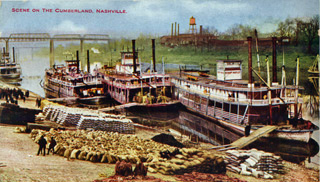 After the Civil War, Nashville quickly grew into an important trade
center. Steamships unloaded their cargo on the banks of the Cumberland
(postcard at right). Its population rose from 16,988 in 1860 to 80,865
by 1900. In
1897, Nashville hosted the Tennessee Centennial and International
Exposition, a World's Fair celebrating the 100th anniversary of
Tennessee's entry into the Union. A replica of the Parthanon was built
for the event. The Parthanon replica is now the centerpiece of
Centennial Park.
After the Civil War, Nashville quickly grew into an important trade
center. Steamships unloaded their cargo on the banks of the Cumberland
(postcard at right). Its population rose from 16,988 in 1860 to 80,865
by 1900. In
1897, Nashville hosted the Tennessee Centennial and International
Exposition, a World's Fair celebrating the 100th anniversary of
Tennessee's entry into the Union. A replica of the Parthanon was built
for the event. The Parthanon replica is now the centerpiece of
Centennial Park. The Great train wreck of 1918 occurred on July 9, 1918, in Nashville when an inbound local train collided with an outbound express, killing 101 people. This was one of the most deadly rail accidents in U.S. history. Tennessee was the state that put the 19th Amendment (allowing women to vote) over the top in 1920.
On March 1, 1941, W47NV (now known as WSM-FM the Wolf) began
operations
in Nashville, becoming the first commercial FM radio station to be
granted an FCC license in the U.S. WSM-AM
started back to 1925 and is primarily associated with the
popularization of country music through its weekly Saturday
night
program the Grand Ole Opry, the longest-running radio program in
history. Nashville played a prominent role in the U.S. civil rights movement. On February 13, 1960, hundreds of college students launched a sit-in campaign to desegregate lunch counters throughout the city. Although initially met with violence and arrests, the protesters were eventually successful in pressuring local businesses to end the practice of racial segregation. Many of the activists involved in the Nashville sit-ins went on to organize the Student Nonviolent Coordinating Committee, which emerged as one of the most influential organizations of the civil rights movement.
The Nashville Tornado of 1998 struck the downtown area on April 16,
1998,
at around 3:30 pm, causing serious damage and blowing out hundreds of
windows from skyscrapers, raining shattered glass on the streets and
closing the business district for nearly four days. Over 300 homes were
damaged, and three cranes at the then-incomplete Adelphia Coliseum were
toppled. Though only one person was killed, it was one of the most
serious urban tornados on record in the United States. Today, Nashville has a population of 607,413 making it the 21st largest city in the United States and the 5th largest state capital (if you were wondering, Phoenix is the largest). The 2005 population of the entire 13-county Nashville Metropolitan Statistical Area was 1,498,836, making it the largest and fastest-growing metropolitan area in the state. |
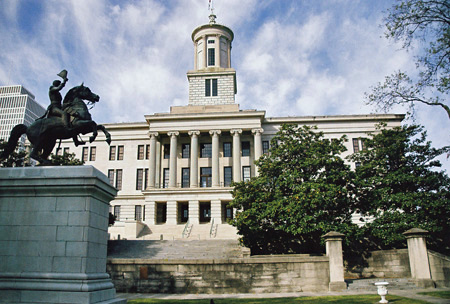 Our first visit was
the state capital which is located on Charlotte and 7th Avenues. The
capitol building, modeled it after a Greek Ionic
temple, is the home of the Tennessee legislature and the governor's
office. It was designed by Philadelphia architect William Strickland,
who was an apprentice of Benjamin Latrobe, the first architect of the
U.S. Capitol building in Washington D.C.
and was constructed over a period of ten years from 1845 to 1855.
Strickland died suddenly a year before the building's completion and
was entombed in the north facade of the building. Strickland also
designed the Downtown Presbyterian Church (formerly known as First
Presbyterian Church of Nashville). The building, which was completed by
his son Francis W. Strickland, was built on Campbell's Hill (or Cedar
Knob),
the highest point in Nashville. The building is constructed of
Tennessee
marble and the labor of erecting it was performed by convicts and
slaves. There are steps you must climb to get to the
building. The building is 236 feet long and 109 feet wide.
Our first visit was
the state capital which is located on Charlotte and 7th Avenues. The
capitol building, modeled it after a Greek Ionic
temple, is the home of the Tennessee legislature and the governor's
office. It was designed by Philadelphia architect William Strickland,
who was an apprentice of Benjamin Latrobe, the first architect of the
U.S. Capitol building in Washington D.C.
and was constructed over a period of ten years from 1845 to 1855.
Strickland died suddenly a year before the building's completion and
was entombed in the north facade of the building. Strickland also
designed the Downtown Presbyterian Church (formerly known as First
Presbyterian Church of Nashville). The building, which was completed by
his son Francis W. Strickland, was built on Campbell's Hill (or Cedar
Knob),
the highest point in Nashville. The building is constructed of
Tennessee
marble and the labor of erecting it was performed by convicts and
slaves. There are steps you must climb to get to the
building. The building is 236 feet long and 109 feet wide. 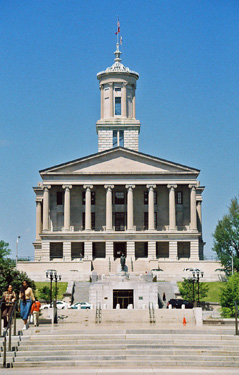 There
is a
terrace or platform 18 feet in width that goes around the entire
building. The Ionic porticos, which have either six or eight columns
(depending on the side of the building) were modeled on the Erechtheum
on the Acropolis in Athens while the Corinthian tower is based on the
Choragic monument of Lysicrates in Athens. From the ground to the top
of the tower is 206 feet.
There
is a
terrace or platform 18 feet in width that goes around the entire
building. The Ionic porticos, which have either six or eight columns
(depending on the side of the building) were modeled on the Erechtheum
on the Acropolis in Athens while the Corinthian tower is based on the
Choragic monument of Lysicrates in Athens. From the ground to the top
of the tower is 206 feet.The above picture is the view from the North with the Jackson statue on the left. The view to the right is from the East or downtown.
During the Civil War, Nashville was dependent on the defense of the Cumberland River downstream where it passed into Kentucky. Protection of the river was dependent on a single fortification called Fort Donelson manned by 12,5000 men. On February 16, 1862, a little over eight months after Tennessee seceded, Fort Donelson surrendered to General Ulysses S. Grant. Nashville was now defenseless. Union General Don Carlos Buell marched towards Nashville, while many important civilians evacuated the city, which surrendered on February 25. It was the first Confederate state capital to be occupied and would remain occupied for the duration of the war.
President Lincoln appointed the only Tennessean senator not to resign, Andrew Johnson, as the military governor of Tennessee. Johnson immediately set out to fortify the state capitol building. Earthworks, cotton bales and wooden palisades were built around the building with heavy mortars trained on the city below. The capitol building became known as "Fort Andrew Johnson."
|
The State Flag of Tennessee
|
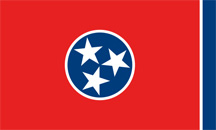 The flag of Tennessee consists of three stars in a circle on a field of
red, with a strip of blue on the edge. The flag was designed by a
soldier named LeRoy Reeves of the 3rd Regiment of Tennessee Infantry
and was officially adopted the state flag on April 17, 1905.
The flag of Tennessee consists of three stars in a circle on a field of
red, with a strip of blue on the edge. The flag was designed by a
soldier named LeRoy Reeves of the 3rd Regiment of Tennessee Infantry
and was officially adopted the state flag on April 17, 1905.On the grounds around the capitol are statues to two Tennessean presidents; Andrew Jackson and Andrew Johnson. The third Tennessean president, James Knox Polk, is actually buried on the grounds (along with his wife). There are also statues to Sam Davis (Civil War hero) and Sgt. Alvin York (World War I hero). The statue of Jackson (that you see in the above photo) is identical to the one in New Orleans.
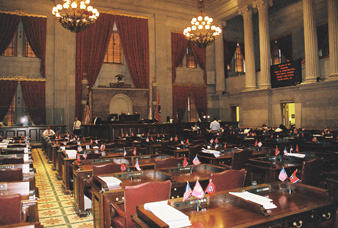 We walked around the building itself. They are very
friendly here and extremely helpful. We even met a Tennessee state
legislature who took the time to stop and say hello. After entering, we
climbed the main stairway, which is thirty feet wide, in the center of
the building to the main floor. We saw both
chambers of the legislature (this is the State Assembly room at left)
along with the governors outer office and
the old state senate chambers. There are numerous busts to famous
people of Tennessee. Among them were the three presidents; Jackson,
Polk and Johnson along with Confederate general Nathan Bedford Forrest.
We walked around the building itself. They are very
friendly here and extremely helpful. We even met a Tennessee state
legislature who took the time to stop and say hello. After entering, we
climbed the main stairway, which is thirty feet wide, in the center of
the building to the main floor. We saw both
chambers of the legislature (this is the State Assembly room at left)
along with the governors outer office and
the old state senate chambers. There are numerous busts to famous
people of Tennessee. Among them were the three presidents; Jackson,
Polk and Johnson along with Confederate general Nathan Bedford Forrest.Of course, one of the places we had to visit after touring the capitol building was the final resting place of President James Knox Polk and his wife, Sarah Childress Polk. Strangely enough, this is Polk's third burial place. Polk, who is our 11th president, died of cholera that he contracted in New Orleans less then four months after leaving office. He was originally buried in the City Cemetery (which we visited later in the week) with 32 other cholera victims in an attempt to stop the spread of the disease. This was temporary, eleven months later Polk was reinterred on the lawn of his home "Polk Place" under a Greek temple-like canopy designed by Strickland (old picture). "Polk Place" was a large two-story mansion with Federal style windows and a Greek Revival colonnade with formal gardens that occupied an entire city block on Union Street between 7th
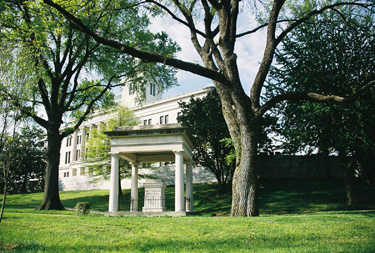 and 8th that
was bought by Polk a year before he left the White House. It was
originally "Grundy Place", the former home of Polk's law mentor Judge
Felix Grundy (who died in 1840) who was a senator and U.S. attorney
general. Polk, who was ill with cholera, didn't get to spend much time
there since he died weeks later, however, his wife, who endured the
longest widowhood of any first lady, lived there for the next 32 years.
During the Civil War, both Union and Confederate troops treated "Polk
Place" as neutral ground. After his wife died in 1891, the columned
mansion, which had become run-down, was sold (The Polk's had no
children to leave it to). Since it is near the capitol building in the
center of Nashville it is prime real-estate. "Polk Place" was torn down
(Polk wanted it donated to the state instead but his heirs managed to
sell it instead) two years later so an apartment complex, the Polk
Flats, could be built. Today, Ben West Public Library is on the spot,
though they do have an historical marker showing you the spot where the
home once stood. So in 1893 (44 years after his death), Polk, along
with his wife and Strickland's monument, was moved to his third, and
hopefully, last location on the hillside near the capitol building
(photo above).
and 8th that
was bought by Polk a year before he left the White House. It was
originally "Grundy Place", the former home of Polk's law mentor Judge
Felix Grundy (who died in 1840) who was a senator and U.S. attorney
general. Polk, who was ill with cholera, didn't get to spend much time
there since he died weeks later, however, his wife, who endured the
longest widowhood of any first lady, lived there for the next 32 years.
During the Civil War, both Union and Confederate troops treated "Polk
Place" as neutral ground. After his wife died in 1891, the columned
mansion, which had become run-down, was sold (The Polk's had no
children to leave it to). Since it is near the capitol building in the
center of Nashville it is prime real-estate. "Polk Place" was torn down
(Polk wanted it donated to the state instead but his heirs managed to
sell it instead) two years later so an apartment complex, the Polk
Flats, could be built. Today, Ben West Public Library is on the spot,
though they do have an historical marker showing you the spot where the
home once stood. So in 1893 (44 years after his death), Polk, along
with his wife and Strickland's monument, was moved to his third, and
hopefully, last location on the hillside near the capitol building
(photo above). There are a few
notable historic sites in Nashville that pertain to the Civil War. the
first is St. Mary's Catholic Church. Its on the corner of Charlotte
Ave. and Fifth Ave. not to far from the state house. Bishop Richard
Miles (who is buried in the church), called the father of the Catholic
Church in Tennessee, wanted the church built to replace the Holy Rosary
Cathedral which was demolished to build the Tennessee State Capitol.
Construction on the church began back in 1844 and was finished in 1847.
They
are not sure who the architect was, but it may have been William
Strickland (who designed the state house).
There are a few
notable historic sites in Nashville that pertain to the Civil War. the
first is St. Mary's Catholic Church. Its on the corner of Charlotte
Ave. and Fifth Ave. not to far from the state house. Bishop Richard
Miles (who is buried in the church), called the father of the Catholic
Church in Tennessee, wanted the church built to replace the Holy Rosary
Cathedral which was demolished to build the Tennessee State Capitol.
Construction on the church began back in 1844 and was finished in 1847.
They
are not sure who the architect was, but it may have been William
Strickland (who designed the state house). During the Civil War, the church was used as a military hospital and they estimate that over 300 soldiers died in the building. During the war, the church had a stone front but has since been encased in stone. It is no longer the cathedral of Nashville and has been replaced by the Cathedral of the Incarnation (completed in 1914). The church was closed when we were there so we did not get a chance to see the inside.
Samuel A. Strictch, a Nashville-born priest who led services here in the 20th century, was Archbishop of Chicago and later the first American appointed by the Pope to the Roman curia.
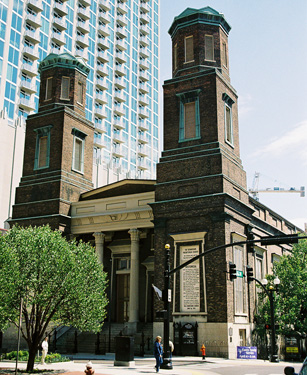 The
Downtown
Presbyterian Church on Fifth Avenue and Church Street is a
national
Historic landmark and an example of Egyptian Revival
architecture.
Completed in 1851 by William Strickland, it was called the First
Presbyterian Church (the name was changed to "Downtown" after First
Presbyterian moved out of downtown Nashville in 1955) replacing an
earlier structure that had burned down in 1848. This is
the third church built on this site.
The
Downtown
Presbyterian Church on Fifth Avenue and Church Street is a
national
Historic landmark and an example of Egyptian Revival
architecture.
Completed in 1851 by William Strickland, it was called the First
Presbyterian Church (the name was changed to "Downtown" after First
Presbyterian moved out of downtown Nashville in 1955) replacing an
earlier structure that had burned down in 1848. This is
the third church built on this site. Presbyterians have worshiped at the corner of Fifth and Church since 1816. In that year the First Presbyterian Church of Nashville built their first structure. Among its early parishioners were Andrew Jackson (he was presented with a ceremonial sword on the steps of the original church after the Battle of New Orleans). After being destroyed by a fire in 1832, a second building was built. The second building hosted the Inauguration of James K. Polk as Governor of Tennessee. The current church had Mrs. Sarah Childress Polk and Adelicia Acklen (of Belmont Mansion fame) as parishioners.
During the Civil War, the church was used as a hospital by the Union Army and had over 200 beds. Inside are a number of Egyptian columns, symbols and paintings which is somewhat unusual for a Christian Church. The columns and pediment on the outside of the church were added after the war. The relief design has a sun disk and cobra which is a common motif in Egyptian art. Some of the designs come from a Temple of Isis in Egypt. When the congregation left in 1955, they were plans to tear down the church to build a parking lot. Instead, they sold it to the members who did not want to leave who have run it ever since. At one time, the church stood out in Nashville, however with construction all around it, it is now dwarfed on almost all sides by skyscrapers. The church was also closed so we could not see the inside.
 The Battle of Nashville
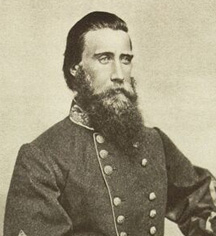
Late in the Civil War, after Sherman captured Atlanta, the Confederate
Army of Tennessee, led by General John Bell Hood (pictured below at
left),
attempted to march
north through Tennessee to capture Nashville. The Army of Tennessee, at
39,000 men, constituted the second-largest remaining army of the
Confederacy, ranking in strength only after Gen. Robert E. Lee's Army
of Northern Virginia. The army consisted of the three infantry corps of
Gen. Benjamin F. Cheatham, Gen. Stephen D. Lee and Gen. Alexander P.
Stewart and cavalry forces under Gen. Nathan Bedford Forrest. |
 In
late September, 1864,
Hood left the Atlanta area and headed north-west towards Tennessee. The
Union Army of the Ohio, with 34,000 men and led by Gen. John M.
Schofield, stayed in front of Hood to slow him down while Gen. George
"The Rock of Chickamauga" Thomas (pictured below at right), with the
Army
of the Cumberland back
in Nashville, consolidated all of the Union forces in the area to
defend the city.
In
late September, 1864,
Hood left the Atlanta area and headed north-west towards Tennessee. The
Union Army of the Ohio, with 34,000 men and led by Gen. John M.
Schofield, stayed in front of Hood to slow him down while Gen. George
"The Rock of Chickamauga" Thomas (pictured below at right), with the
Army
of the Cumberland back
in Nashville, consolidated all of the Union forces in the area to
defend the city.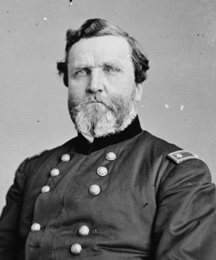 It
took most of the
morning of December 16 for Thomas to move his men into position against
Hood's new line. Once again, Thomas planned a two-phase attack but
concentrated on Hood's left. By 4 p.m., Cheatham, on Shy's Hill, was
under assault from three sides, and his corps broke and fled to the
rear. Other Union troops renewed their attacks and overwhelmed the
Confederates. Darkness fell, and heavy rain began. Hood collected his
forces and withdrew to the south toward Franklin.
It
took most of the
morning of December 16 for Thomas to move his men into position against
Hood's new line. Once again, Thomas planned a two-phase attack but
concentrated on Hood's left. By 4 p.m., Cheatham, on Shy's Hill, was
under assault from three sides, and his corps broke and fled to the
rear. Other Union troops renewed their attacks and overwhelmed the
Confederates. Darkness fell, and heavy rain began. Hood collected his
forces and withdrew to the south toward Franklin.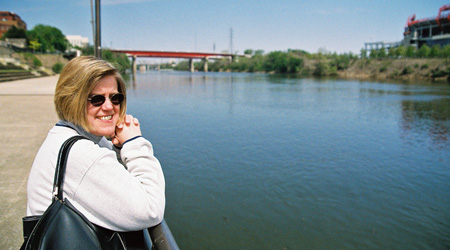 The Cumberland River
is 687 miles long of which 381 miles is navigable (from Celina,
Tennessee to the Ohio River). It starts in Harlan County in eastern
Kentucky on the Cumberland Plateau, flows through southeastern Kentucky
before crossing south into northern Tennessee, and then curves back up
north into western Kentucky before draining into the Ohio River at
Smithland, Kentucky. The Cumberland is one of three major Kentucky
rivers with headwaters there. The others are the Kentucky River and the
Big Sandy River. Stones River, just east of Nashville, flows north into
the Cumberland River.
The Cumberland River
is 687 miles long of which 381 miles is navigable (from Celina,
Tennessee to the Ohio River). It starts in Harlan County in eastern
Kentucky on the Cumberland Plateau, flows through southeastern Kentucky
before crossing south into northern Tennessee, and then curves back up
north into western Kentucky before draining into the Ohio River at
Smithland, Kentucky. The Cumberland is one of three major Kentucky
rivers with headwaters there. The others are the Kentucky River and the
Big Sandy River. Stones River, just east of Nashville, flows north into
the Cumberland River.Here is Debbie standing on the southern bank of the Cumberland River in Nashville. Unlike many other cities we have visited, there is almost nothing going on by or on the river in Nashville. This wasn't always true, but it is now.
In 1748, Dr. Thomas Walker led a party of hunters across the Appalachian Mountains from Virginia. Walker, a Virginian, was a well-known explorer and surveyor. He gave the name "Cumberland" to the range of mountains his party crossed, in honor of Prince William Augustus, Duke of Cumberland (a younger son of King George II of Great Britain and future uncle of King George III) whose name became popular in America after the Battle of Culloden in Scotland. Previous to Walker's trip, the Cumberland River had been called Warioto by Native Americans and Shauvanon by French traders.
The Cumberland River is a wild river above the headwaters of Lake Cumberland. Cumberland Falls, a 68-foot waterfall on this section of river, is one of the largest waterfalls in the eastern United States, and the only place in the Western Hemisphere where a moonbow (night rainbows) can be seen. Most of the river below Lake Cumberland's Wolf Creek Dam is navigable because of a number of locks and dams.
Several Civil War battles occurred near the Cumberland River, including the battle for Fort Donelson. The Union Army of the Cumberland, one of the principal Union armies in the Western Theater of the war, was named after the river.
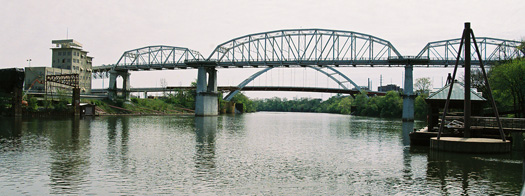 The Shelby Street
Bridge (photo at right looking upriver) is a multi-span truss bridge
over the Cumberland River opened
back in 1909. The Shelby Street Bridge was originally known as the
Sparkman Street Bridge and was built one block south of Broadway,
connecting Sparkman Street and Shelby Avenue. It was built
simultaneously with the Jefferson Street Bridge, which was almost its
perfect twin. In contemporary postcards the two bridges appear as
impressive structures, the substructure a light gray or white concrete,
the superstructure elegant arches of black steel.
The Shelby Street
Bridge (photo at right looking upriver) is a multi-span truss bridge
over the Cumberland River opened
back in 1909. The Shelby Street Bridge was originally known as the
Sparkman Street Bridge and was built one block south of Broadway,
connecting Sparkman Street and Shelby Avenue. It was built
simultaneously with the Jefferson Street Bridge, which was almost its
perfect twin. In contemporary postcards the two bridges appear as
impressive structures, the substructure a light gray or white concrete,
the superstructure elegant arches of black steel.The Sparkman Street Bridge performed its function for about 25 years, when time and the weather showed that there was something wrong with the concrete on the 3,150 ft. long Sparkman Street Bridge. The worn surfaces of the concrete were chipped away between 1927 and 1930 and replaced with gunite (sprayed concrete). However, the weathering continued, and the bridge had to be repaired a second time, in the early 1960’s. By 1992, the bridge was declared to be in poor condition and by 1997 it was closed to all vehicles. The bridge was originally slated for demolition. However, due to aesthetic, architectural and historical considerations, it was decided that it should be converted to a pedestrian bridge rather than be demolished (similar to a bridge in Chattanooga). It was added to the National Register of Historic Places in 1998.
The bridge was refurbished, at a cost in excess of $15 million, and an elevator, ramps and stairways were added. The bridge has a center lane that is fifteen feet across to accommodate bicycles. Originally it was thought that a trolley might use the center lane, but that idea was abandoned in favor of a bicycle lane. On each side of the bicycle lane are ten foot wide elevated boardwalk-style sidewalks. The bridge includes four scenic pedestrian overlooks that, in the metal of the railing, have artistic renderings of the history of life on the Cumberland River. The bridge is also lit at night.
In 1989, the Jefferson Street Bridge was included in a state-wide survey of metal truss bridges to determine which were potentially eligible for the National Register. Because the bridge is an exact copy of the Shelby Street Bridge, which was in better condition, the Jefferson Street Bridge was not eligible and subsequently demolished in 1990. It was replaced by the new Jefferson Street Bridge.
We took the stairs to the bridge and walked across to the north side of the Cumberland River near LP Stadium. The bridge is probably used a lot during football games so fans can walk back to downtown Nashville. I am told that it can also be seen in a number of country music videos.
 Broadway is the
main country music street in Nashville. There are many country bars
crowded
into a small three-block strip of Broadway that
are alive with country
music, especially on Saturday nights. You can start at one end on Fifth
Avenue near the Ryman Auditorium and walk towards the river where you
will find a
"non-country" institution, The
Hard Rock Cafe. Many of the
clubs, like Robert's Western World, The Stage, Legends Corner,
Tootsie's Orchid Lounge (painted
in lavender), Wolfy's and Jim &
Layla's, have live music on most nights. The clubs do not have any
cover charges so you can wander, or what the locals say, do a pub
crawl, from one club to another listening to the music. It sounded good
to me, but Debbie was not into crawling into bars.
Broadway is the
main country music street in Nashville. There are many country bars
crowded
into a small three-block strip of Broadway that
are alive with country
music, especially on Saturday nights. You can start at one end on Fifth
Avenue near the Ryman Auditorium and walk towards the river where you
will find a
"non-country" institution, The
Hard Rock Cafe. Many of the
clubs, like Robert's Western World, The Stage, Legends Corner,
Tootsie's Orchid Lounge (painted
in lavender), Wolfy's and Jim &
Layla's, have live music on most nights. The clubs do not have any
cover charges so you can wander, or what the locals say, do a pub
crawl, from one club to another listening to the music. It sounded good
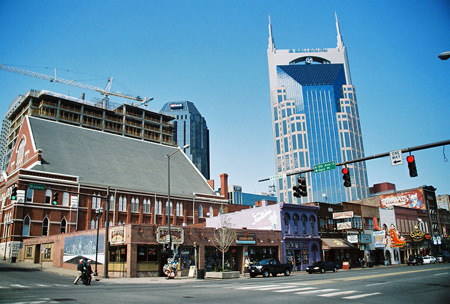
to me, but Debbie was not into crawling into bars.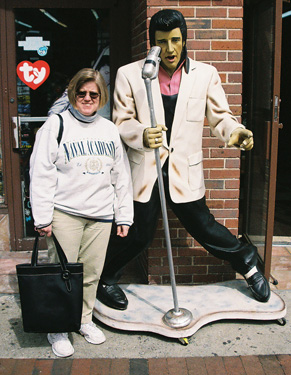 In the picture above here, taken at the intersection of
Broadway and Fifth Avenue, you can see many of the bars and restaurants
that line the west side of Broadway between Fifth and Fourth Avenues. Legends
Corner is on the corner. You can
see the lavender painted Orchid Lounge in the center. Further to the
right is Robert's
Western World, Jack's
Bar-bar-que (with its distinctive orange sign) and The
Stage. Going up Fifth Avenue you can see the Ryman Auditorium (site of
the Grand Ole Opry from 1943
until 1974). Beyond Broadway, across the street from the Ryman
Auditorium, is the BellSouth Tower (tallest building in Tennessee) and further
north is One
Nashville Place. On the other side of the parking lot next to the Ryman
Auditorioum is another large building going up in Nashville. This
picture was taken from in front of the Sommet Center (formerly
Nashville Arena) were the Nashville Predators play.
In the picture above here, taken at the intersection of
Broadway and Fifth Avenue, you can see many of the bars and restaurants
that line the west side of Broadway between Fifth and Fourth Avenues. Legends
Corner is on the corner. You can
see the lavender painted Orchid Lounge in the center. Further to the
right is Robert's
Western World, Jack's
Bar-bar-que (with its distinctive orange sign) and The
Stage. Going up Fifth Avenue you can see the Ryman Auditorium (site of
the Grand Ole Opry from 1943
until 1974). Beyond Broadway, across the street from the Ryman
Auditorium, is the BellSouth Tower (tallest building in Tennessee) and further
north is One
Nashville Place. On the other side of the parking lot next to the Ryman
Auditorioum is another large building going up in Nashville. This
picture was taken from in front of the Sommet Center (formerly
Nashville Arena) were the Nashville Predators play. There are a number of inexpensive restaurants with good food, like Jack's Bar-bar-que (more on them below). There are also a number of souvenir stores with statues of Elvis outside. You wouldn't believe how much it took to convince this tourist, and Elvis hater, to have her picture taken with "The King" (next to Legends Corner). Ironically, despite the number of statues and other references to him, Elvis is not connected to Nashville, but to Memphis, 200 miles to the west. He only performed at the Grand Old Opry once and never came back (more on that below).
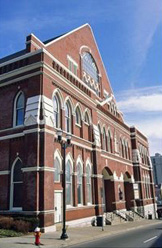 The Ryman Auditorium
was first opened as the Union Gospel Tabernacle in 1892. It was built
by Thomas Ryman (1843–1904), a riverboat captain and Nashville
businessman. After his death, the Tabernacle was renamed Ryman
Auditorium in his honor. There is a modern statue to Ryman outside the
auditorium. It was used for Grand
Ole Opry broadcasts from 1943 until 1974. There is a bronze
statue to Roy Acuff and Minne Pearle inside (photo below). They give
tours of the
auditorium which is one of the attractions on the "Music City Total Access
Attraction Pass".
The Ryman Auditorium
was first opened as the Union Gospel Tabernacle in 1892. It was built
by Thomas Ryman (1843–1904), a riverboat captain and Nashville
businessman. After his death, the Tabernacle was renamed Ryman
Auditorium in his honor. There is a modern statue to Ryman outside the
auditorium. It was used for Grand
Ole Opry broadcasts from 1943 until 1974. There is a bronze
statue to Roy Acuff and Minne Pearle inside (photo below). They give
tours of the
auditorium which is one of the attractions on the "Music City Total Access
Attraction Pass".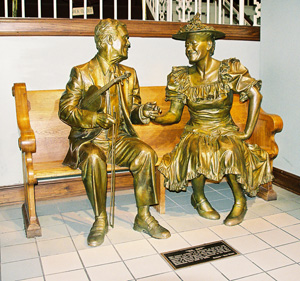 Along
with Acruff and Pearle,
many of the greats of country music have performed at the Ryman over
the years, including Johnny Cash, Garth Brooks, Patsy Cline, Tennessee
Ernie Ford, Glen Campbell and Reba McEntire. However not just Country
stars have performed here. Among the countless other artists who have
performed on the Ryman stage are Enrico
Caruso, Elvis
Presley, Jerry Lee Lewis, Bruce Springsteen, James Brown, Bob Dylan,
The Byrds, Neil Diamond, Jon Bon Jovi, Van Morrison, the Vienna Boys
Choir and the New York Philharmonic Orchestra. It has been said to have
the second best acoustics in the world (after the Mormon Tabernacle
Choir's home, the Salt Lake Tabernacle). They still have a very active
schedule of musical events today.
Along
with Acruff and Pearle,
many of the greats of country music have performed at the Ryman over
the years, including Johnny Cash, Garth Brooks, Patsy Cline, Tennessee
Ernie Ford, Glen Campbell and Reba McEntire. However not just Country
stars have performed here. Among the countless other artists who have
performed on the Ryman stage are Enrico
Caruso, Elvis
Presley, Jerry Lee Lewis, Bruce Springsteen, James Brown, Bob Dylan,
The Byrds, Neil Diamond, Jon Bon Jovi, Van Morrison, the Vienna Boys
Choir and the New York Philharmonic Orchestra. It has been said to have
the second best acoustics in the world (after the Mormon Tabernacle
Choir's home, the Salt Lake Tabernacle). They still have a very active
schedule of musical events today.The Ryman Auditorium has been featured in several movies, including Robert Altman's Nashville (1975), Coal Miner's Daughter (1980) and Honkytonk Man (1982).
When you are in Nashville you must see the Grand Ole Opry. To celebrate our 8th Anniversary, I bought tickets for their Tuesday, April 10 night show. Wyndham Resorts had a shuttle bus to take us there so it was very convenient. The night we went we got to see Porter Wagoner, Little Jimmy Dickens. What I found interesting is that instead of seats they have pews.
The Grand Ole Opry is a weekly Saturday night country music radio program broadcast live on WSM radio in Nashville and televised on Great American Country network. It is the oldest continuous radio program in the United States, having been broadcast on WSM since November 28, 1925. Very recently, they added Tuesday nights. It originally started out as the WSM Barn Dance in the new fifth floor radio station studio of the National Life & Accident Insurance Company in downtown Nashville. The featured performer on the first show was Uncle Jimmy Thompson, a fiddler who was then 77 years old. As audiences to the live show increased, National Life & Accident Insurance's radio venue became too small to accommodate the large amounts of fans. They moved a couple of times before settling in the 2,362-seat Ryman Auditorium on Fifth Avenue off Broadway.
 On October 2, 1954, a teenage Elvis
Presley made his first (and only) performance there. It didn't go over
very well and he vowed never to return. The Ryman was home to the Opry
until 1974, when the show moved to the new 4,400-seat Grand Ole Opry
House (photo at left), located east of downtown Nashville (near the
Wyndham Resorts) on
a former farm in the Pennington Bend of the Cumberland River. They
actually cut a circle from the stage of the Ryman and placed on the
stage of the new auditorium. To get
on stage you must be a member of the Grand Ole Opry which includes new
stars, superstars and legends. Some of the more famous members past and
present include Minnie Pearle, Roy Acuff, Hank Williams Sr., Charley
Pride, Loretta Lynn, Ronnie Milsap, Tammy Wynette and Dolly Parton.
On October 2, 1954, a teenage Elvis
Presley made his first (and only) performance there. It didn't go over
very well and he vowed never to return. The Ryman was home to the Opry
until 1974, when the show moved to the new 4,400-seat Grand Ole Opry
House (photo at left), located east of downtown Nashville (near the
Wyndham Resorts) on
a former farm in the Pennington Bend of the Cumberland River. They
actually cut a circle from the stage of the Ryman and placed on the
stage of the new auditorium. To get
on stage you must be a member of the Grand Ole Opry which includes new
stars, superstars and legends. Some of the more famous members past and
present include Minnie Pearle, Roy Acuff, Hank Williams Sr., Charley
Pride, Loretta Lynn, Ronnie Milsap, Tammy Wynette and Dolly Parton.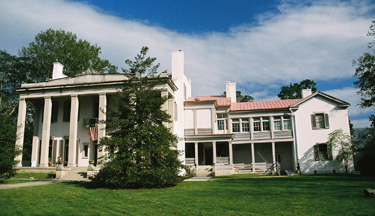 By the early
1860's, General Harding,
who was a secessionist, thought Tennessee should leave the union and
join the new Confederacy. He gave $500,000 to support the Southern
cause and was appointed to a position on the Military and Financial
Board for Tennessee. Nashville was forced to surrender to the Union in
1862 and the new military governor, Andrew Johnson (future president)
had Harding and other Confederate supporters in the city arrested.
General Harding was convicted and sent to Mackinaw Island in Michigan
for six months.
By the early
1860's, General Harding,
who was a secessionist, thought Tennessee should leave the union and
join the new Confederacy. He gave $500,000 to support the Southern
cause and was appointed to a position on the Military and Financial
Board for Tennessee. Nashville was forced to surrender to the Union in
1862 and the new military governor, Andrew Johnson (future president)
had Harding and other Confederate supporters in the city arrested.
General Harding was convicted and sent to Mackinaw Island in Michigan
for six months. Prior to the Battle of Nashville, Belle Meade became the headquarters of Confederate General James R. Chalmers, who commanded Hood's cavalry division. On December 15, 1864, during the first day of the battle, Union troops occupied Belle Meade while Chalmers men were off fighting. They returned and were fired on by Union troops in front of Belle Meade as they were trying to escape. Harding's daughter Selene was on the front porch weaving a handkerchief at the Confederate horseman as they rode past with bullets flying all around. Selene was untouched but the mansion's massive stone columns were riddled with bullets which you can still see today.
Racing regained popularity after the war and Belle Meade recuperated. Mrs. Elizabeth Harding died in 1867 leaving her daughter Selene to manage household affairs. Selene married a retired Confederate General, William Hicks Jackson, in 1868 (he was a cavalry general and led troops in General Nathan Bedford Forrest's command). Following a stroke in 1883 (he died three years later), General Harding turned the Belle Meade farm over to Jackson. Jackson added to the mansion and even hosted President Grover Cleveland and his new wife in 1884. By the 1880's Belle Meade had gained national attention. General Jackson purchased a stallion named Iroquois in 1886, the first American winner of the English derby. Iroquois was used to breed future champion race horses. Recent Kentucky derby winners like Funny Cide and Barbarro, even racing legends like Secretariat and Seabiscuit can trace their bloodlines back to the breeding stock at Belle Meade.
Jackson died in 1903 and his son William inherited the farm, but he died suddenly months after. The farm was sold and most of it was developed into the wealthy suburb of Belle Meade (Al Gore lives here).
In 1953, Belle Meade Mansion and eight outbuildings on 30 acres were deeded to the Association for the Preservation of Tennessee Antiquities, and is today managed by the Nashville chapter of the Association. There are tours of the main house plus you can walk around the grounds and look at the other buildings on the grounds. The carriage house and stables are impressive. There are also the buildings used for slave quarters as well as a smokehouse and a dairy. You can also visit the old family mausoleum which is off in the trees. It's empty now but once held a number of family members.
|
Nashville Sports
The
Nashville Predators joined the N.H.L. in 1998 and currently play in the
Sommet Center (formerly Nashville Arena). The team was named after the
fossil skull of a saber-toothed cat, a species extinct for at least
10,000 years, that was found in August 1971, in a cave during the
excavation for the AmSouth Center in downtown Nashville. Fans of the
Nashville Predators have modified a tradition of the Detroit Red Wings
to show their support: on occasion, a fan will throw a catfish onto the
ice. The Predators
have advanced to the Conference Quarterfinals before being eliminated
they did not qualify in their first five seasons). The last two seasons
the San Jose Sharks have ended their season. In 2006-07, the set a
francise record with 51 wins. There all-time leading scorer, Finish
defenseman Kimmo Timonen, was passed by American center David Legwand
in 2008. In the 2007-08 season, the Predators met the eventual Stanley
Cup champion Detroit Red Wings in the first round of the playoffs, and
were defeated in six games - their fourth straight first round
knockout. There was discussion of a new owner buying the
team and relocating them to Hamilton, Ontario by the 2008-09 season,
however, it appears that a local group interested in keeping them in
Nashville has bought the team instead.
Since their incredible 1999 season, the Titans have
advanced to the
playoffs in 2000, 2002 and 2003, but won only two playoff games in
those three years. Since then they have finished out of the playoffs
for the last three years until 2007.
The name Titans comes from Nashville's history as the
"Athens of the
South" and the fact that they have a full-scale replica of the
Parthanon. In Greek mythology, the Titans were a race of powerful
deities that ruled during the legendary Golden Age. The Titans were
overthrown by the gods called the Twelve Olympians, led by Zeus.
Nashville never had a Major League Baseball team, but it’s
first
professional baseball team was organized back in 1885 in the
newly-formed Southern League and the park was referred to as Athletic
Park. That same year, Cap Anson brought the Chicago Cubs to Nashville
for three weeks of spring training. From 1901 to 1963, the Double-A
Nashville Vols baseball team of the Southern Association (folded in 1961) played
in Sulphur Dell (a notorious hitter's park often called "Suffer Hell"
by pitchers and outfielders). It was the old Athletic Park until
Grantland Rice, sports editor of the Tennessean,
renamed it Sulphur Dell. In 1901, Nashville opened it's season with a
three game sweep over the Chattanooga Lookouts. Since 1934, the Vols
were affiliated with six major league teams (Giants, Dodgers, Cubs,
Reds, Twins and Angels). Their team featured two Hall of Fame players
through the years. New York Yankee pitcher Wait Hoyt played for them in
1918 and outfielder Kiki Cuyler (who played for the Pirates, Cubs, Reds
and Brooklyn Dodgers) played for them in 1923. In 1961, Vice-president
Lyndon Johnson threw out the first pitch in the opening game. The
Nashville Vols, along with the rest of the Southern Association, kept
to the Jim Crow segregation laws of the time and never permitted an
African-American to play in the league, even after Jackie Robinson
broke the color barrier in 1948.
Also playing in Sulpher Dell were the semi-pro Nashville Standard
Giants of the Negro
League. The Standard Giants, later known as the Elite Giants, played in
Nashville from 1921 until they moved to Cleveland and became the
Cleveland Cubs and joined the first Negro National League. After the
league folded, they returned to Nashville, changed the name back to the
Elite Giants and joined the Negro Southern League. When the second
incarnation of the Negro National League was formed in 1932, the Giants
joined it for the following two seasons. In 1935, the team left
Nashville for good and moved to Columbus, Ohio and became the Columbus
Elite Giants. After moves a short stay in Washington D.C., they played
in Baltimore from 1938 to 1950 as the Baltimore Elite Giants (they disbanded after the 1950 season).
|
 Nashville has several professional sports
teams, most notably the
Nashville Predators of the N.H.L. and the Tennessee Titans of the
N.F.L. Several other pro sports teams also call Nashville home, as does
the NCAA college football Music City Bowl. The Vanderbilt Commodores
are members of the Southeastern Conference. The football team of
Tennessee State University plays its home games at LP Field.
Nashville has several professional sports
teams, most notably the
Nashville Predators of the N.H.L. and the Tennessee Titans of the
N.F.L. Several other pro sports teams also call Nashville home, as does
the NCAA college football Music City Bowl. The Vanderbilt Commodores
are members of the Southeastern Conference. The football team of
Tennessee State University plays its home games at LP Field. In 1997, the Houston Oilers left Texas for Tennessee.
After a year
of playing in Liberty Bowl Memorial Stadium in Memphis (which turned
out to be a disaster due in part to the unwillingness of many Nashville
fans to make the 210-mile trip to Memphis and many Memphis fans not
wanting to support a team they would lose in a year) until a new
stadium could be built, the Tennessee Oilers opened their season in
Nashville in 1998. Originally they did not want to play in 41,000 seat
Vanderbilt Stadium, but after the Memphis deal did not work out, they
were forced to. In 1999, Adelphia Coliseum, now known as LP Field, was
completed and the newly christened Tennessee Titans had their best
season ever, finishing with a 13-3 record, the best season in franchise
history. They finished one game behind the Jacksonville Jaguars for the
AFC Central title. Tennessee then won their first round playoff game
over the Buffalo Bills on a controversial play that became known as the
"Music City Miracle." They next beat the Indianapolis Colts and
Jacksonville Jaguars to advance to Super Bowl XXXIV where they
ultimately lost to the St. Louis Rams, 23-16.
In 1997, the Houston Oilers left Texas for Tennessee.
After a year
of playing in Liberty Bowl Memorial Stadium in Memphis (which turned
out to be a disaster due in part to the unwillingness of many Nashville
fans to make the 210-mile trip to Memphis and many Memphis fans not
wanting to support a team they would lose in a year) until a new
stadium could be built, the Tennessee Oilers opened their season in
Nashville in 1998. Originally they did not want to play in 41,000 seat
Vanderbilt Stadium, but after the Memphis deal did not work out, they
were forced to. In 1999, Adelphia Coliseum, now known as LP Field, was
completed and the newly christened Tennessee Titans had their best
season ever, finishing with a 13-3 record, the best season in franchise
history. They finished one game behind the Jacksonville Jaguars for the
AFC Central title. Tennessee then won their first round playoff game
over the Buffalo Bills on a controversial play that became known as the
"Music City Miracle." They next beat the Indianapolis Colts and
Jacksonville Jaguars to advance to Super Bowl XXXIV where they
ultimately lost to the St. Louis Rams, 23-16. Professional baseball was absent
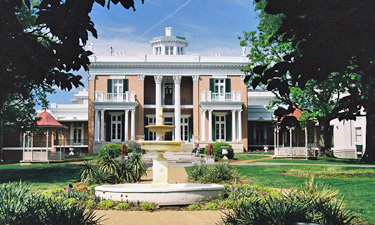 1817
(Hayes was a cousin of future
president Rutherford B. Hayes). After her first fiancé died
before the wedding, Adelicia, at age 22,
married a wealthy 50-year old wealthy
cotton planter and slave trader named
Isaac Franklin. They had four children but none lived into their teens
and after seven years, Franklin died leaving Adelicia very rich. Her inheritance was
valued at approximately $1 million which included seven
Louisiana cotton plantations, a 2,000 acre farm in Middle
Tennessee and around 750 slaves.
1817
(Hayes was a cousin of future
president Rutherford B. Hayes). After her first fiancé died
before the wedding, Adelicia, at age 22,
married a wealthy 50-year old wealthy
cotton planter and slave trader named
Isaac Franklin. They had four children but none lived into their teens
and after seven years, Franklin died leaving Adelicia very rich. Her inheritance was
valued at approximately $1 million which included seven
Louisiana cotton plantations, a 2,000 acre farm in Middle
Tennessee and around 750 slaves.Three years later, Adelicia married a young lawyer named Joseph Acklen in 1849. He was an excellent businessman who tripled Adelicia's fortune. They built Belle Monte (Belmont), an Italianate-style villa, it was a summer home to escape the heat of her 8,400 acre Louisiana cotton plantation. The Acklens built, furnished, and landscaped one of the most elaborate antebellum homes in the South, with 36 rooms and 19,000 sq. ft. The estate contained an art gallery, conservatories, lavish gardens, aviary, lake and zoo. They had six children (four of whom survived). After the fall of Nashville during the Civil War, Joseph stayed on the Louisiana plantation where he passed away. At the end of the war, she had 2,8000 bales of cotton which the Confederates were going to destroy to keep it out of the hands of the Union. By herself, Adelicia traveled south and secretly negotiated agreements with both sides to allow her cotton to be shipped to New Orleans and then to England where it was sold for $960,000 in gold.
Even though Belmont Mansion was just inside the Union outer defensive line and was the headquarters of Union General Thomas J. Wood, commander of the Union IV Corp, the house was not touched during the Battle of Nashville.
After the war, Adelicia traveled to England (to get her gold) and then Europe creating a large art collection including five large marble statues (four of which are still in the mansion today). In 1867, she married her third husband, Dr. William Arthur Cheatham of Nashville. Together they lived at Belmont for the next 20 years. They separated in 1886 and Adelicia sold the mansion and moved to Washington D.C. She died the following year while shopping in New York City.
Today, the mansion and grounds are part of Belmont University, a liberal arts university that is the largest Christian university and the second largest private university in Tennessee and is run by the Tennessee Baptist Convention. They are famous for their music programs (Minnie Pearle and Mary Martin graduated from her when it was Ward-Belmont College). They are still doing restoration work in the mansion. We saw one of the rooms, what is called a Tete a Tete Room, having restoration work done while we were there.
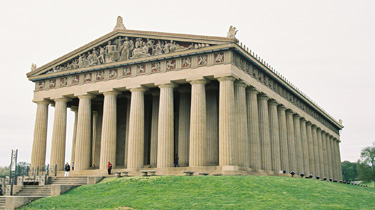 Without a doubt, it's most
interesting attraction is a full-scale model of the Athenian Parthanon.
The
replica of the original Parthanon in Athens serves as a
monument to what is considered the pinnacle of classical architecture. Built
mostly out of plaster, it wasn't meant to be permanent and should have
been taken down when the Exposition was over. However, the people of
Nashville wanted it to stay to keep in it's tradition of being the
"Athens of the South." Finally, in the 1920's they replaced the
temporary plaster building with a permanent, concrete and steel
replacement (completed in 1931). It functions today primarily as an art
gallery. There is a small fee to go inside but we had free passes from
our Nashville tickets.
Without a doubt, it's most
interesting attraction is a full-scale model of the Athenian Parthanon.
The
replica of the original Parthanon in Athens serves as a
monument to what is considered the pinnacle of classical architecture. Built
mostly out of plaster, it wasn't meant to be permanent and should have
been taken down when the Exposition was over. However, the people of
Nashville wanted it to stay to keep in it's tradition of being the
"Athens of the South." Finally, in the 1920's they replaced the
temporary plaster building with a permanent, concrete and steel
replacement (completed in 1931). It functions today primarily as an art
gallery. There is a small fee to go inside but we had free passes from
our Nashville tickets.The original Parthanon in Athens was carved out of Pentelic marble and it took the Greeks approximately ten years to construct the building, finishing in 438 B.C. The permanent one here in Nashville also took ten years to re-build. It is an exact replica. It is 228 feet long, 101 feet wide and 65 feet high at the top of the apex. The peristyle consists of 46 Doric columns, 17 on each side and six on each end (not counting the corner columns twice). The interior of the Parthanon is divided into two rooms. The east room is called the Naos and it houses the statue of Athena. The Naos is 93 feet long and 63 feet wide and has a two-story colonnade around three sides. The west room is 44 feet long by 63 feet wide and is called the Treasury Room. In Ancient Athens, this room housed the treasure of Athens and the Delian League.
The East side is considered the front and that is where we entered. However, you don't enter through the massive doors but rather through a smaller sidewalk entrance below. This leads into the lower art museum and adjacent gift shop. The bronze doors weight seven and a half tons each. They measure 24' high, 7' wide and 1' thick. There are two sets (4 doors total) of these enormous doors in the Parthanon. This makes them the largest set of matching bronze doors in the world. The Parthanon doors in Ancient Athens were only slightly lighter and were wooden with a bronze covering.
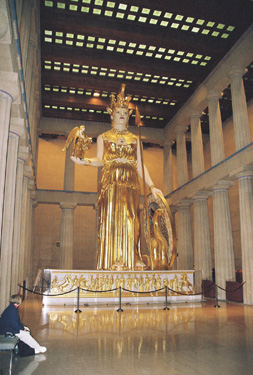 Historians
believe the Parthanon was built as a temple dedicated to the goddess
Athena. It also believed to have contained a large statue to the famous
goddess. So in 1982, they decided to re-create a statue of Pallas
Athena, said to be the largest indoor sculpture in the Western world,
inside. It was created by Nashville sculptor Alan LeQuire. Owing to the
completeness and the multiple color surface painting (called
polychrome), this replica is arguably closer to what the Athenians saw
than are the current ruins in Athens. The statue almost 42 feet tall.
There are about 12 inches between the top of her helmet and the ceiling
beams. Her weight is estimated at 12 tons. The statue of Nike, the
goddess of victory, in Athena's right hand is 6 feet 4 inches tall.
Nike holds a wreath of victory preparing to crown Athena. The five foot
high marble pedestal on which Athena stands is decorated with
bas-relief panels depicting the goddesses and gods present at Pandora’s
birth. Scholars
also now believe there was a shallow pool of water extending from
immediately in from of the statue to the fourth column. The water would
have functioned like a mirror to bounce light onto the statue and may
also have increased the room’s humidity, thus preventing the ivory from
becoming brittle. They did not recreate the reflecting pool here.
Historians
believe the Parthanon was built as a temple dedicated to the goddess
Athena. It also believed to have contained a large statue to the famous
goddess. So in 1982, they decided to re-create a statue of Pallas
Athena, said to be the largest indoor sculpture in the Western world,
inside. It was created by Nashville sculptor Alan LeQuire. Owing to the
completeness and the multiple color surface painting (called
polychrome), this replica is arguably closer to what the Athenians saw
than are the current ruins in Athens. The statue almost 42 feet tall.
There are about 12 inches between the top of her helmet and the ceiling
beams. Her weight is estimated at 12 tons. The statue of Nike, the
goddess of victory, in Athena's right hand is 6 feet 4 inches tall.
Nike holds a wreath of victory preparing to crown Athena. The five foot
high marble pedestal on which Athena stands is decorated with
bas-relief panels depicting the goddesses and gods present at Pandora’s
birth. Scholars
also now believe there was a shallow pool of water extending from
immediately in from of the statue to the fourth column. The water would
have functioned like a mirror to bounce light onto the statue and may
also have increased the room’s humidity, thus preventing the ivory from
becoming brittle. They did not recreate the reflecting pool here.I was very impressed with the statue of Athena inside, however, Debbie thought it looked like a giant cheap chachi. This is probably because the original statue was covered in ivory, which has a glossy appearance, while the recreation has a flat white finish looking more like plaster.
Recreating the statue wasn't easy. Pheidias, the greatest sculptor of classical antiquity, constructed the original Athena Parthenos on a wooden framework with carved ivory for skin and a gold wardrobe. The statue was unveiled and dedicated in 438 or 437 B.C. Unfortunately, the gold and ivory statue was lost by the 400 A.D. So finding descriptions of the statue wasn't easy. Athena appears on Athenian coins of the second and first centuries B.C. Romans later copied the statue in small-scale. Even today on the Acropolis you can see
 the
outline of Athena's base on
the floor of the Parthanon. It's made of gypsum cement over a steel
frame and took eight years to build and when it was done in 1990 was a
plain, white statue. In 2002, they guilded the statue and painted her
face, clothing and shield to make Athena appear that much closer to the
ancient Athena Parthenos.
the
outline of Athena's base on
the floor of the Parthanon. It's made of gypsum cement over a steel
frame and took eight years to build and when it was done in 1990 was a
plain, white statue. In 2002, they guilded the statue and painted her
face, clothing and shield to make Athena appear that much closer to the
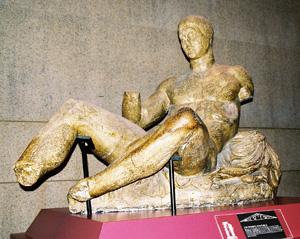
ancient Athena Parthenos. Also inside are plaster replicas of the Parthanon Marbles, called the Elgin Marbles. These are direct casts of the original sculptures which adorned the East and West pediments, called the Parthanon Frieze. The actual fragments were removed from Athens and sent to Great Britain in 1806 by Thomas Bruce, 7th Earl of Elgin, ambassador to the Ottoman Empire (at the time the Ottoman Empire occupied Greece). The sculptures were later placed in the British Museum in London in 1816 where they can be seen today. The British Museum holds approximately half of the surviving sculptures. The Greek government has been trying, unsuccessfully, to get them back.
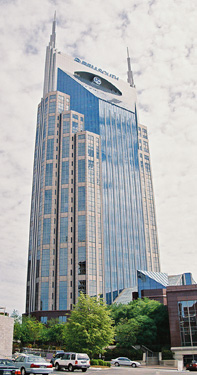 Nashville seems to
be going through a building boom. Everywhere we look, there is
construction of one thing or another. Some of the modern buildings in
Nashville are interesting and are in contrast to what was here.
Nashville seems to
be going through a building boom. Everywhere we look, there is
construction of one thing or another. Some of the modern buildings in
Nashville are interesting and are in contrast to what was here.The tallest building in Nashville as well as Tennessee is the BellSouth Building on Third Avenue North and Commerce Street. Designed by Earl Swensson Associates, the 33-story building is called affectionately by locals as the "Batman Building" for its sleek profile with twin spires similar to the superhero's pointed ears. The 617-ft. structure has a communications dish atop the main part of the building which is covered by the tri-star design, representing the "Volunteer" symbol of the Tennessee state flag. Completed in 1994, it has become a symbol of the Nashville skyline. Though the building still shows the logo for the defunct BellSouth, it is the regional headquarters of AT&T Southeast (BellSouth's successor). Originally the plan for the building was to not have any spires, but only the decorative bridge. This look would have made the top of the skyscraper look more like a receiver of a telephone in its cradle. The building's current styling is similar to the Melbourne Central Tower in Melbourne, Australia.
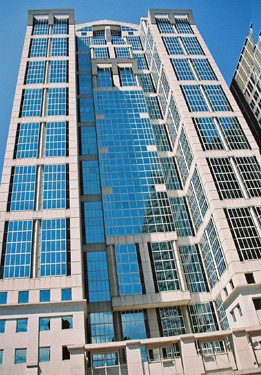 One of the more interesting buildings is the
30-story Financial Center (photo on left) on Church Street. Originally
built as the
Third National Financial Center, this 490-ft. building was Nashville's
first Postmodern skyscraper, utilizing decorative motifs adapted from
historic structures. Designed by Kohn Pedersen Fox Associates PC, the
sloping columns and curved cornices were inspired by William
Strickland's Downtown Presbyterian Church across the street (I took the
photo from the steps of the church). The gable roof at the crown is
typical of the Postmodern style. It was the tallest building in
Nashville as well as Tennessee from 1986 until 1994, when it was
surpassed by the nearby BellSouth Building. Today it ranks as the fifth
tallest skyscraper in Nashville.
One of the more interesting buildings is the
30-story Financial Center (photo on left) on Church Street. Originally
built as the
Third National Financial Center, this 490-ft. building was Nashville's
first Postmodern skyscraper, utilizing decorative motifs adapted from
historic structures. Designed by Kohn Pedersen Fox Associates PC, the
sloping columns and curved cornices were inspired by William
Strickland's Downtown Presbyterian Church across the street (I took the
photo from the steps of the church). The gable roof at the crown is
typical of the Postmodern style. It was the tallest building in
Nashville as well as Tennessee from 1986 until 1994, when it was
surpassed by the nearby BellSouth Building. Today it ranks as the fifth
tallest skyscraper in Nashville.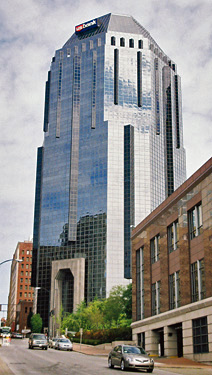 The ninth tallest building in Nashville is One
Nashville Place (photo at right) on Fourth Avenue and Commerce Street
(the photo is looking west on Fourth Street). Completed in 1985, this
359-ft. octagonal building with dark glass exterior has 23 floors. It
has been given the nickname R2D2 by the locals after the character in
the Star Wars movies.
The ninth tallest building in Nashville is One
Nashville Place (photo at right) on Fourth Avenue and Commerce Street
(the photo is looking west on Fourth Street). Completed in 1985, this
359-ft. octagonal building with dark glass exterior has 23 floors. It
has been given the nickname R2D2 by the locals after the character in
the Star Wars movies.Here is a photo of some older Nashville buildings on Fifth Avenue with the Nashville City Center in the background. The Nashville City Center,
 designed
by The Stubbins Associates, Inc. (the
architect of the Citicorp Center in New York City), was completed in
1988. The 27-story building is on Union
Street between Fifth
and Sixth Avenues. At 402-ft., it's the second tallest building in
Nashville.
designed
by The Stubbins Associates, Inc. (the
architect of the Citicorp Center in New York City), was completed in
1988. The 27-story building is on Union
Street between Fifth
and Sixth Avenues. At 402-ft., it's the second tallest building in
Nashville.Between Third and Fourth Avenues is a small pedestrian alley. This is the old Printers Alley, which runs behind the buildings facing Third and Fourth Avenues. A long time ago there were many print shops (including famous Hatch Show Print) downtown in this area. It was also commonly called "The Men's Quarters", the city's red light district, as there were many bars, gambling houses and houses of prostitution. Nashville was well known in the late 1800's for its numerous posh saloons and gambling houses. By the 1970's the Printers Alley and surrounding area were run down and kind of seedy, home to many bars and clubs. Today, the area has been restored and is filled with music clubs, upscale restaurants, professional offices and stuff like that.
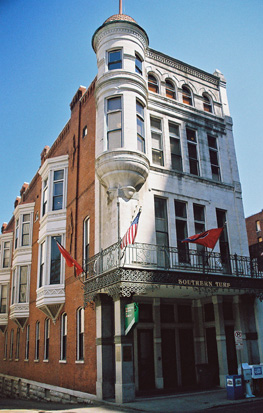 The last picture is of the
Southern Turf Saloon. Located
on Fourth Avenue between Church and Union streets, with the rear facing
Printers Alley, the Southern Turf was once one of the city's most
elegant saloons, decorated with mirrors, bronze statuary, fine
paintings and marble halls. The
Queen Anne-style building was constructed in 1895 by a wealthy
bookmaker, Marcus Cartwright. The four-story brick structure possesses
ornate detailing and rich textures with bay windows, a distinctive
turret and a New Orleans style balcony with an ironwork railing.
The last picture is of the
Southern Turf Saloon. Located
on Fourth Avenue between Church and Union streets, with the rear facing
Printers Alley, the Southern Turf was once one of the city's most
elegant saloons, decorated with mirrors, bronze statuary, fine
paintings and marble halls. The
Queen Anne-style building was constructed in 1895 by a wealthy
bookmaker, Marcus Cartwright. The four-story brick structure possesses
ornate detailing and rich textures with bay windows, a distinctive
turret and a New Orleans style balcony with an ironwork railing. The popular saloon started to go downhill with the arrival of prohibition. In 1909, Tennessee passed its own Prohibition Laws ahead of the 19th Amendment. A man named Ice Johnson ran the saloon for Cartwright until it closed ion 1916 at which time Johnson shot and killed himself. Between 1916 and 1937, The Southern Turf was the home of one of Nashville's leading newspapers, The Nashville Tennessean.
After 1937, many different businesses occupied the building. It housed a billiard hall, a restaurant, a shooting gallery, a clothing store, and a paint store. Between 1916 and 1982 the building underwent several unfortunate "remodeling." The interior was stripped of its formerly opulent furnishings and part of the facade was covered with unsightly modern materials. In 1982, the building's new owners undertook a project to restore The Southern Turf to its former respectability and architectural appeal. Today it house law firms.
Across Fourth Avenue from the Southern Turf Saloon once stood the five-story, 240-room Maxwell House Hotel. Construction, using slave labor, began in 1859. Colonel John Overton Jr. built the hotel which he named for his wife, Harriet Maxwell Overton. During the Civil War, the partially finished brick building served as both barracks and prison hospital for the occupying Union army. After the war Overton resumed construction of what became Nashville's largest hotel, which local citizens initially called "Overton's Folly." Opening in the fall of 1869, it was for years the center of Nashville's social and political life.
An urban legend has it that when a visiting Teddy Roosevelt in 1907 drank their coffee he proclaimed it was, “good to the last drop” (the slogan was actually written by a president of General Foods Corporation). Maxwell House Coffee is named after the hotel which served it. Other visitors included Thomas Edison, Henry Ford, "Buffalo Bill" Cody, Cornelius Vanderbilt and George Westinghouse. The Maxwell House burned down on Christmas night in 1961.
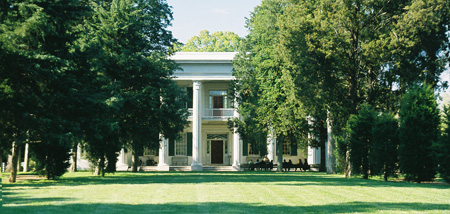 The Hermitage is not
only the name of
Jackson's home but of the surrounding farm. The land, which was ideally
located two miles from the Cumberland and Stone’s rivers, was
originally settled by a Nathaniel Hays in 1780. Hays sold the 640-acre
farm to Jackson in 1804. Jackson and his wife Rachel moved into a
two-story log cabin on the farm (the two-story building was eventually
split into two one-story buildings used as slave quarters after Jackson
build a main house). Initially Jackson operated the cotton farm with
nine African-American slaves, but this number gradually grew to 44
slaves by 1820 as the farm expanded to 1,000 acres. The original
Hermitage mansion was a two-story 8-room
Federal style brick
building built between 1819 and 1821. 1828 was the height and depth of
Jackson's life. In November, he was elected 7th President of the United
States, however, his wife Rachel died the following month. In 1831,
while Jackson was away in the White House, he had the mansion remodeled
with flanking one-story wings (one with a library and the other with a large
dining room and pantry), a
two-story entrance portico with Doric columns and a small rear portico.
Jackson also had a Grecian “temple & monument” for Rachel Jackson's
grave constructed in the garden. Craftsmen completed the domed
limestone
tomb with a copper roof in 1832. In 1834 a chimney fire seriously
damaged much of the building. This prompted Jackson to have the current
Greek Revival structure built which was completed two years later.
The Hermitage is not
only the name of
Jackson's home but of the surrounding farm. The land, which was ideally
located two miles from the Cumberland and Stone’s rivers, was
originally settled by a Nathaniel Hays in 1780. Hays sold the 640-acre
farm to Jackson in 1804. Jackson and his wife Rachel moved into a
two-story log cabin on the farm (the two-story building was eventually
split into two one-story buildings used as slave quarters after Jackson
build a main house). Initially Jackson operated the cotton farm with
nine African-American slaves, but this number gradually grew to 44
slaves by 1820 as the farm expanded to 1,000 acres. The original
Hermitage mansion was a two-story 8-room
Federal style brick
building built between 1819 and 1821. 1828 was the height and depth of
Jackson's life. In November, he was elected 7th President of the United
States, however, his wife Rachel died the following month. In 1831,
while Jackson was away in the White House, he had the mansion remodeled
with flanking one-story wings (one with a library and the other with a large
dining room and pantry), a
two-story entrance portico with Doric columns and a small rear portico.
Jackson also had a Grecian “temple & monument” for Rachel Jackson's
grave constructed in the garden. Craftsmen completed the domed
limestone
tomb with a copper roof in 1832. In 1834 a chimney fire seriously
damaged much of the building. This prompted Jackson to have the current
Greek Revival structure built which was completed two years later.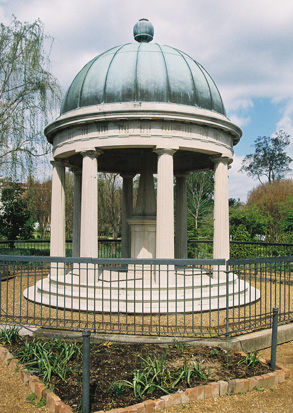 In 1837, Jackson left
Washington D.C. after his two terms had expired and returned to the
Hermitage. He lived here until his death on June 8, 1845 when two days
later he was buried in the garden next to his wife (photo at left).
Jackson is buried on the left side with his wife Rachel buried on the
right. Next to this monument is the rest of the family cemetery.
In 1837, Jackson left
Washington D.C. after his two terms had expired and returned to the
Hermitage. He lived here until his death on June 8, 1845 when two days
later he was buried in the garden next to his wife (photo at left).
Jackson is buried on the left side with his wife Rachel buried on the
right. Next to this monument is the rest of the family cemetery.We walked from the Visitor Center to the front of the mansion. Being one of the first to arrive that day, we were alone on the tour. They don't have one guide show you around, but rather have costumed historical interpreters stationed throughout the mansion along a specific route. The most disappointing part of the tour is that they don't allow you to enter any rooms. In fact, all of the rooms have glass doors so all you can do is look in. Visitors are relegated to the hallways only. Of all the Presidential Homes I have visited, this is the only one that was set up like this. It was kind of like looking into a fishtank.
You do get to see all of the rooms but it is hard to really enjoy the experience. We saw Jackson's bedroom that he died in. It has a portrait of his wife Rachel hanging in it. They said it was because Jackson wanted to see her last thing at night and first thing in the morning.
After Jackson died in 1845 the Hermitage went downhill. His adopted son Andrew Jackson, Jr. (1808-1865) inherited the 1,050-acre plantation and 161 slaves but because of financial problems was forced to sell it to the State of Tennessee in 1856. Tennessee allowed the Jackson's to live at the Hermitage until they could decide what to do with it. There were many ideas like making it a southern branch of the U.S. Military Academy at West Point to an “Executive Mansion” for the governor of Tennessee. The Jackson's lived at the Hermitage during the Civil War. Although several important battles took place at Nashville and in the surrounding region, no military action took place near The Hermitage. After the war, the 13th Amendment freed all of the Hermitage slaves.
Andrew Jackson, Jr. died in 1865 and the plantation slowly fell into disrepair. After the war, Tennessee had little money for rebuilding vital infrastructure, much less maintaining a state-owned historic site. In the 1870's and 1880's, as Nashville grew into a southern commercial center, there was a desire to save The Hermitage. In 1889, Tennessee chartered the Ladies’ Hermitage Association or LHA (an organization modeled on the Mount Vernon Ladies’ Association who had purchased and opened George Washington’s Mount Vernon) who opened Jackson's home as a museum. They are responsible for preserving and maintaining the Hermitage to this day. They have through the years bought back the entire 1,050-acre farm that Jackson owned. Today it receives more than a quarter million visitors, making it the 4th most visited presidential residence in the country (after the White House, Mount Vernon and Monticello).
The Hermitage escaped a near-disaster during the Nashville Tornado of 1998. An F-3 tornado crossed the property at approximately on April 16, 1998, missing the house and gravesite, but toppling many trees that had reportedly been planted by Jackson himself nearly 200 years earlier.
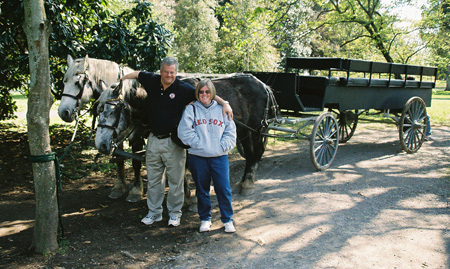 After touring the mansion,
Debbie and I took a Changing Landscape guided tour of the grounds. We
had a historian walk around the grounds with us explaining about the
layout of the land in the Jackson's lifetime. After this we had to
leave to make our lunch appointment on the General Jackson, but we
returned in the afternoon (our tickets are good for the whole day).
After touring the mansion,
Debbie and I took a Changing Landscape guided tour of the grounds. We
had a historian walk around the grounds with us explaining about the
layout of the land in the Jackson's lifetime. After this we had to
leave to make our lunch appointment on the General Jackson, but we
returned in the afternoon (our tickets are good for the whole day). We took a half-hour tour of the Hermitage grounds by horse-drawn wagon (this cost an additional $7 but it was good). We went past the First Hermitage where Jackson lived from 1804 to 1821, to the site of the Cotton Gin and Press, to the Field Quarters and to several archaeological sites associated with slavery and farming. After the tour we walked around a bit and visited the museum in the Visitor Center. We, of course, visited the gift shop before driving away.
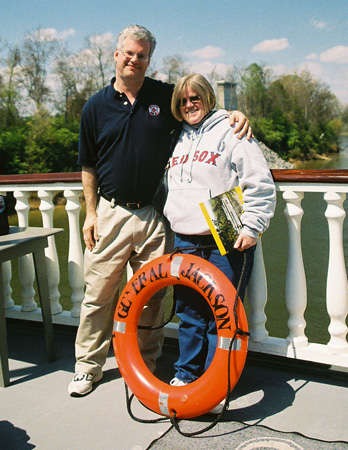 We purchased tickets
for a lunch trip on General Jackson Showboat.
The
boat takes a 3-hour river tour on the Cumberland River. We
boarded at
the Pennington Bend near the Opry Mills shopping center not to far from
the Wyndham Resorts where we were staying. The General Jackson is a 274-foot-long
stern paddle-wheel vessel (300
feet including the gang plank) resembling one of the paddlewheel
riverboats that cruised the Southern rivers in the 1800's. The ship,
which was built in 1985, is 63.5 feet wide and 55 feet high (77 feet to
top of folding stacks) with a draft of only seven feet. It has a 36
feet long, with a 24 foot diameter, paddlewheel in the stern the moves
the General Jackson at a top
speed of 13 mph (the average speed is between 4 and 8 mph).
We purchased tickets
for a lunch trip on General Jackson Showboat.
The
boat takes a 3-hour river tour on the Cumberland River. We
boarded at
the Pennington Bend near the Opry Mills shopping center not to far from
the Wyndham Resorts where we were staying. The General Jackson is a 274-foot-long
stern paddle-wheel vessel (300
feet including the gang plank) resembling one of the paddlewheel
riverboats that cruised the Southern rivers in the 1800's. The ship,
which was built in 1985, is 63.5 feet wide and 55 feet high (77 feet to
top of folding stacks) with a draft of only seven feet. It has a 36
feet long, with a 24 foot diameter, paddlewheel in the stern the moves
the General Jackson at a top
speed of 13 mph (the average speed is between 4 and 8 mph).Here we are on the top front deck. One of the other passengers took the picture. They also got the life preserver figuring it would make a better picture.
They have a day time lunch cruise and also a dinner cruise. We took the lunch cruise that also has a show. The two and a half hour cruise lunch cruise includes an all-you-can-eat southern buffet. The ship leaves at 12 noon and cruises on a
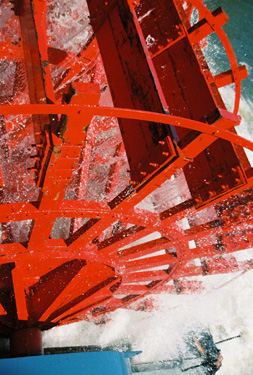 14-mile
roundtrip to downtown Nashville and back. The trip we were on had Tim
Watson as the show. It was half country music and half comedy. We
didn't think we would enjoy the show, however we did. You
don't have to book the show or lunch cruise and just sit outside and
enjoy the view or they have a live band playing on the top or Hurricane
Deck. We took a time out from the show to step outside when the General
Jackson got to downtown Nashville. At this point, the ship turns around
and heads back upriver to the Opry Mills Shopping Center.
14-mile
roundtrip to downtown Nashville and back. The trip we were on had Tim
Watson as the show. It was half country music and half comedy. We
didn't think we would enjoy the show, however we did. You
don't have to book the show or lunch cruise and just sit outside and
enjoy the view or they have a live band playing on the top or Hurricane
Deck. We took a time out from the show to step outside when the General
Jackson got to downtown Nashville. At this point, the ship turns around
and heads back upriver to the Opry Mills Shopping Center.The General Jackson was named after the first paddle-wheel river steamboat to operate on the Cumberland River in 1817 that was named for Andrew Jackson. These ships are more famously associated with the Mississippi River and Mark Twain but were once used on many rivers in the South. Because of their shallow, flat bottomed construction
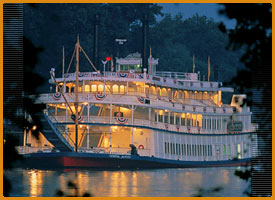 they
could nose up
almost anywhere along a riverbank to pick up or drop off passengers and
freight. Unfortunately, the hard usage they were subjected to and
inherent flexibility of their shallow wooden hulls meant that
relatively few of them had careers longer than a decade. Today, there
are almost no remaining 19th century paddle-wheel river steamboat
around.
they
could nose up
almost anywhere along a riverbank to pick up or drop off passengers and
freight. Unfortunately, the hard usage they were subjected to and
inherent flexibility of their shallow wooden hulls meant that
relatively few of them had careers longer than a decade. Today, there
are almost no remaining 19th century paddle-wheel river steamboat
around.We went to the back to see the paddle-wheel. It is a huge 24 ft. diameter red paddlewheel (pictured here), churning up an immense amount of water. They have a protective screen to keep the water from being splashed on the back decks and on the paying customers.
Construction of Travelers Rest began in 1799 by Judge John Overton, one of Tennessee's most influential citizens and a friend of Andrew Jackson (the two of them were instrumental in founding the settlement of Memphis). Jackson, whose home at the Hermitage, was miles to the north, often stayed as a guest in the house. The original house was two stories and had four rooms. Because of his harsh traveling schedule as a judge, Overton called his home "Traveler's Rest." During the next 30 years, Overton added to the house enlarging it. The biggest addition came in 1828 when he extended on to the back of the house to connect it to a brick structure he had built earlier. This included the large porch which I like so much. Once this was done, the main entrance of the house shifted from the front to the side were the porch is.
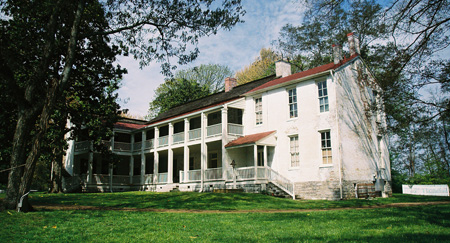 Judge
Overton died in 1833 and
his son John Jr., though not the official owner (his mother lived until
1862), ran the place. John
Overton, Jr. had opposed secession for Tennessee when the state
took its first vote in February 1861. However, after the firing
on Ft.
Sumter and President Lincoln’s call for 75,000 men to put down the
rebellion, Overton, like many other middle Tennesseans, switched when a
second secession vote was taken in May. When Nashville was occupied by
the Union, Overton, like many others, was forced to leave the city. He was
given the honorary title of colonel for his service to the Confederate
government. In December of 1864, for two weeks the house became the
headquarters of Confederate General John Bell Hood after the Battle of
Franklin and before the Battle of Nashville. They even have the bed he
most likely slept in. By this time in the war, Bell had lost his right
leg and the use of his left arm and, they believe, would have slept
downstairs. Other generals like Nathan Bedford Forrest slept in another
bedroom upstairs. During this time, Colonel Overton returned to the
house for the first time since 1862.
Judge
Overton died in 1833 and
his son John Jr., though not the official owner (his mother lived until
1862), ran the place. John
Overton, Jr. had opposed secession for Tennessee when the state
took its first vote in February 1861. However, after the firing
on Ft.
Sumter and President Lincoln’s call for 75,000 men to put down the
rebellion, Overton, like many other middle Tennesseans, switched when a
second secession vote was taken in May. When Nashville was occupied by
the Union, Overton, like many others, was forced to leave the city. He was
given the honorary title of colonel for his service to the Confederate
government. In December of 1864, for two weeks the house became the
headquarters of Confederate General John Bell Hood after the Battle of
Franklin and before the Battle of Nashville. They even have the bed he
most likely slept in. By this time in the war, Bell had lost his right
leg and the use of his left arm and, they believe, would have slept
downstairs. Other generals like Nathan Bedford Forrest slept in another
bedroom upstairs. During this time, Colonel Overton returned to the
house for the first time since 1862.On December 15, 1864, Union General George Thomas launched an attack that has been called the Battle of Nashville. Hood's Army of Tennessee, behind defenses were overwhelmed by the attack and forced to pull back. The next day, Thomas resumed his attack. On Peach Orchard Hill, located on the Overton plantation not far from the house, several regiments of United States Colored Troops were repulsed by an entrenched Confederate position (one regiment lost five color bearers). That did not deter the Union advance at Shy’s Hill further west on the Confederate left where 40,000 Union soldiers attacked and routed 5,000 Confederates. By 4 o’clock in the afternoon, the overwhelming Union attack sent the Confederates in full retreat south. Southern casualties numbered over 6,000 while the Union numbered 2,900.
Colonel Overton died in 1898 - in the room in which he was born - and his wife Harriet followed him two months later. Their son inherited Travelers Rest and lived there until his death in
It was here on Christmas Day in 1779 that James Robertson and his group of North carolinians crossed the Cumberland River and settled down in what would become Nashville. On April 2, 1781, a force of Chickamaugans led by Dragging Canoe attacked the fort at the bluffs (this has been called "the Battle of the Bluff"). The Indians succeeded in luring most of the men out of the fort and then cutting them off from the entrance. But the whites managed to escape back to the fort while the Chickamaugans captured their horses. They also had help from the fort's dogs, turned loose by the women. Outside the fort is a sculpture of town founders James Robertson and John Donelson shaking hands in 1780, representing the beginning of Nashville's history
The museum is set up that as you walk along you go through history from the past to the present. The first part deals with what the museum calls "The First Tennesseans." These are Prehistoric Indian cultures that existed in Tennessee and ending with modern tribes as the Cherokee and Chickasaw. Next is the Frontier which describes how Spanish conquistadors were the first Europeans to reach Tennessee, followed by the French and English explorers and then by the first white settlers. They have a frontier cabin, 200-year-old dugout canoe, a grist mill, a Conestoga wagon and Daniel Boone's musket.
Next you enter the Age of Jackson. The exhibit doesn't just focus on Jackson, but on this time period in American history when government, both on the state and national levels, became more responsive to the "common" people. Here there are displays on Jackson, David Crockett, Sam Houston and President James K. Polk. Next is the Antebellum Period (Pre-Civil War) in Tennessee. The Antebellum period of 1840 to 1860 was a time of prosperity and cultural development. Cities and towns became trade centers, as railroads and steamboats drew people closer together. There is a display on African American life that points out that one-fourth of Tennessee's population were blacks who not only did not share in the state's prosperity but also lived as slaves unable to control their own lives.
 From here you enter The
Civil War and Reconstruction period. Tennessee was unique among the
Southern states that seceded and joined the Confederacy. While the
state voted to secede, many people in East Tennessee supported the
Union and even fought in the Union Army. Tennessee was the primary
battlefield of the Civil War in the west, with more than 400 battles
and skirmishes. Each of the major battles in Tennessee is highlighted
with artifacts from the battlefield. They say, the Tennessee State
Museum's holdings of uniforms, battle flags and weapons are among the
best in the nation. Along with these artifacts are General Patrick
Cleburne's cap and Nathan Bedford Forrest's revolver. There is also
some exhibits dealing with Andrew Johnson, 17th President of the United
States.
From here you enter The
Civil War and Reconstruction period. Tennessee was unique among the
Southern states that seceded and joined the Confederacy. While the
state voted to secede, many people in East Tennessee supported the
Union and even fought in the Union Army. Tennessee was the primary
battlefield of the Civil War in the west, with more than 400 battles
and skirmishes. Each of the major battles in Tennessee is highlighted
with artifacts from the battlefield. They say, the Tennessee State
Museum's holdings of uniforms, battle flags and weapons are among the
best in the nation. Along with these artifacts are General Patrick
Cleburne's cap and Nathan Bedford Forrest's revolver. There is also
some exhibits dealing with Andrew Johnson, 17th President of the United
States.The last part is focused on the New South and the post-Civil War industrial revolution including the 1897 Tennessee Centennial Exposition. There are a number of artifacts from this period including a large collection of Tennessee pottery from the late 19th and early 20th centuries (yawn) and a very interesting late 19th century steam-powered fire engine.
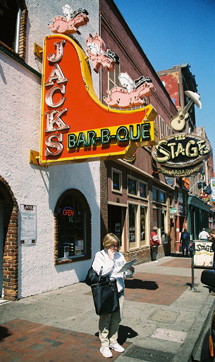 The first Nashville place
we ate at was on our first day. We stopped in for lunch at Jack's Bar-B-Que at 416
Broadway (between Robert's Western World and The Stage). This was one
of
the places recommended on the Food Network. I
was wearing my Boston Red Sox sweatshirt as we were standing outside
reading the menu when the manager came out and told me that since I was
a Red Sox fan, the cook inside would buy me lunch. We went in and true
to his word, the cook (also a Red Sox fan) bought me lunch. The place
is a very popular spot in Nashville. It wasn't crowded, but then it was
only a little after 11:00 a.m. We enjoyed our lunch and had a good talk
about the local sports teams. Our friend is not only a Red Sox fan, but
a big follower of the Predators. They had their opening playoff game
the next night and he was confident (they lost to the Sharks in
overtime and eventually the series).
The first Nashville place
we ate at was on our first day. We stopped in for lunch at Jack's Bar-B-Que at 416
Broadway (between Robert's Western World and The Stage). This was one
of
the places recommended on the Food Network. I
was wearing my Boston Red Sox sweatshirt as we were standing outside
reading the menu when the manager came out and told me that since I was
a Red Sox fan, the cook inside would buy me lunch. We went in and true
to his word, the cook (also a Red Sox fan) bought me lunch. The place
is a very popular spot in Nashville. It wasn't crowded, but then it was
only a little after 11:00 a.m. We enjoyed our lunch and had a good talk
about the local sports teams. Our friend is not only a Red Sox fan, but
a big follower of the Predators. They had their opening playoff game
the next night and he was confident (they lost to the Sharks in
overtime and eventually the series). For lunch, I had the Texas Beef Brisket plate which I recommend. All plates are served with two side items and bread (I had the baked beans as one). On our last day in Nashville, we stopped by Jack's again for lunch. We arrived after 12 and this time the place was packed. I had the brisket again (when you have a winner you stick with it).
The Jack in the name is for Jack Cawthon who opened the original Jack's Bar-B-Que on the corner of Broadway and 1st Avenue in a tiny concrete block building next to Riverfront Park in 1976. Later, Jack lost his lease and the building was torn down to make way for a parking lot for a new Hard Rock Cafe. Instead of closing, Jack moved his business up Broadway and opened a new restaurant around the corner from the Ryman Auditorium among the many country music bars.
There is an interesting story behind the sign for Jack's Bar-B-Que. Apparently when Planet Hollywood put up a huge sign over their Broadway restaurant it without permission. A councilman responded, "“I guess the next thing will be Pigs over Broadway.” Cawthon responded with his famous sign with the flying pigs over Broadway.
For dinner, we went to Rotier's Restaurant. According to Food Network, they have some of the best cheeseburgers in the country. How could we pass this up. It's located at 2413 Elliston Place next to Centennial Park. It doesn't look like much from the outside, but don't be fooled, it's fine inside. Debbie and I both enjoyed our cheeseburgers. They also have great milk shakes and that staple of Southern cooking - the "meat-and-three."
For breakfast on Wednesday, we went to the Pancake Pantry. This is another Food Network recommendation. It is near Vanderbilt University at 1796 21st Ave. S. The place is large, but it was very busy for a weekday morning. They have quite a selection of pancakes here. Debbie had the recommended sweet potato pancakes with the cinnamon cream syrup.
On Thursday, we drove back from Franklin and stopped in Ted's Montana Grill for dinner. It's located at 2817 West End Avenue near Vanderbilt University and Centennial Park. This is not a local tradition but rather a chain restaurant, however we figured we would try it anyway. Our waiter talked me into having my first bison burger. It has less fat so it's not a juicy as a ground beef burger, but it was juicy enough.
 On our last night in
Nashville, we decided to try the Loveless
Motel & Cafe. Frommer's says it has the best traditional
southern cuisine. It was quite a drive to get to. It is quite a
distance south of downtown Nashville on Route 100. However, it was
worth the trip. The first thing you see when you go in are the many
pictures on the wall. It seems like everyone has been there and left an
autographed picture.
On our last night in
Nashville, we decided to try the Loveless
Motel & Cafe. Frommer's says it has the best traditional
southern cuisine. It was quite a drive to get to. It is quite a
distance south of downtown Nashville on Route 100. However, it was
worth the trip. The first thing you see when you go in are the many
pictures on the wall. It seems like everyone has been there and left an
autographed picture. We wanted to try the Capitol Grille in the lower level of the upscale Hermitage Hotel. However, their lunch menu was from 11:30 a.m. to 2 p.m. and we somehow couldn't fit it into our schedule. We also wanted to try F. Scott's Restaurant and Jazz Bar but ran out of time. Of course, there is always next trip to Nashville.
Up until this time, I knew little about the Battle of Franklin. I knew it was a Confederate victory that came with terrible losses and that six generals were killed in the battle, but not much else. There were actually two separate battles fought here. The first battle was much smaller and occurred on April 10, 1863 that ended up being a Union victory with less then 300 casualties. The Second Battle of Franklin (simply as The Battle of Franklin) which occurred on November 30, 1864 was a Confederate victory with over 8,500 casualties.
|
The Battle of Franklin
The Confederate
Army of Tennessee, led by General John Bell Hood, marched
north through Tennessee towards Nashville in late 1864 with the goal of
capturing Nashville. The army consisted of 38,000 men divided into the
three infantry corps of
Gen. Benjamin F. Cheatham, Gen. Stephen D. Lee and Gen. Alexander P.
Stewart and cavalry forces under Gen. Nathan Bedford Forrest. |
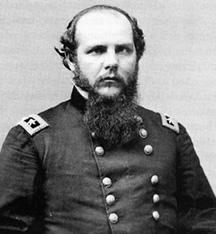 The Union Army of the
Ohio, with
34,000 men led by Gen. John M. Schofield (picture at left), stayed in
front of Hood
to slow him down. On November 29, Hood engaged Schofield at the battle
of Spring Hill. Hood had failed to destroy Schofield's army and the
Army of the Ohio managed to escape. Hood had hoped to destroy Schofield
before he could link up with the Gen. Thomas, farther north in
Nashville.
The Union Army of the
Ohio, with
34,000 men led by Gen. John M. Schofield (picture at left), stayed in
front of Hood
to slow him down. On November 29, Hood engaged Schofield at the battle
of Spring Hill. Hood had failed to destroy Schofield's army and the
Army of the Ohio managed to escape. Hood had hoped to destroy Schofield
before he could link up with the Gen. Thomas, farther north in
Nashville.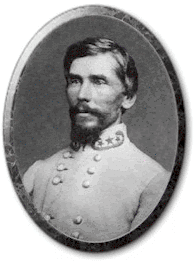 The Confederates continued
to futilely smash headlong into the Union line. Just before dark, the
division of Maj. Gen. Edward “Allegheny” Johnson arrived, and it had no
more luck than its predecessors. By 9:00 p.m. the fighting subsided.
The overall attack had been awesome, described by some as a tidal wave
and known as the “Pickett's Charge of the West.” However, it was
actually much larger than the famous charge at Gettysburg. At
Gettysburg, 12,500 Confederates crossed a mile of open ground in a
single assault that lasted about 50 minutes. At Franklin, some 20,000
marched into the guns across two miles and conducted seventeen distinct
assaults lasting over five hours.
The Confederates continued
to futilely smash headlong into the Union line. Just before dark, the
division of Maj. Gen. Edward “Allegheny” Johnson arrived, and it had no
more luck than its predecessors. By 9:00 p.m. the fighting subsided.
The overall attack had been awesome, described by some as a tidal wave
and known as the “Pickett's Charge of the West.” However, it was
actually much larger than the famous charge at Gettysburg. At
Gettysburg, 12,500 Confederates crossed a mile of open ground in a
single assault that lasted about 50 minutes. At Franklin, some 20,000
marched into the guns across two miles and conducted seventeen distinct
assaults lasting over five hours.
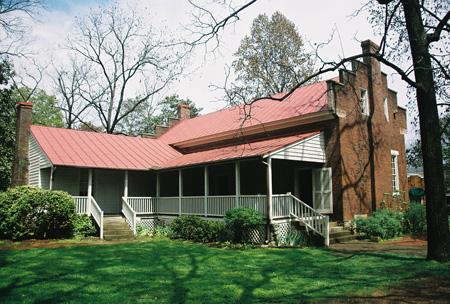 After
driving into the center of town, we first visited the Carter House
on
the west side of Columbia Turnpike. The Carter House, built in 1830 by
Fountain Branch
Carter, was right in the center of some of the most intense
fighting in
the Civil War. There is a Visitor Center here with a museum and gift
shop. We bought our tickets ($8.00) and first saw the movie. While the
movie was recounting the battle, we could hear a low rumbling sound,
which at first was thought to be artillery in the movie but was in
reality a heavy thunderstorm passing over Franklin.
After
driving into the center of town, we first visited the Carter House
on
the west side of Columbia Turnpike. The Carter House, built in 1830 by
Fountain Branch
Carter, was right in the center of some of the most intense
fighting in
the Civil War. There is a Visitor Center here with a museum and gift
shop. We bought our tickets ($8.00) and first saw the movie. While the
movie was recounting the battle, we could hear a low rumbling sound,
which at first was thought to be artillery in the movie but was in
reality a heavy thunderstorm passing over Franklin. After the movie, we took a tour of the house and grounds. The guide (who was a Red Sox fan) showed us the outbuildings that was full of bullet holes from the battle. On the morning of the battle, the parlor of the house was commandeered by Federal General J.D. Cox as his headquarters, and was used as such until shortly prior to the battle. During the battle there was fierce fighting all around the house. General John C. Brown's Division of 3,000 men, which was made up of four Confederate Brigades led by Generals Gist, Carter, Gordon and Strahl, almost all Tennessee men, converged on this area. General States Rights Gist and General Otho Strahl would be killed not too far from the house. Members of the 1st Ohio Battery A artillery along with the 44th Missouri, 50th Ohio, 183 Ohio and 72 Illinois regiments of Colonel Silas Strickland's Brigade held the line in front of the house. The Confederates broke through the line and captured the cannons of the 1st Ohio. Just as the Confederates were about to exploit their
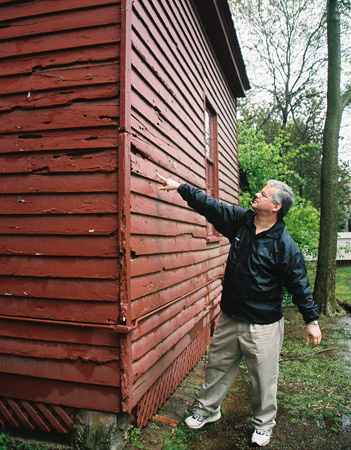 breakthrough,
Colonel Emerson Opdycke of Ohio, whose brigade of 2,000 men were in
reserve further up the road from the Carter House, ordered his men,
mostly men from
Illinois along with Ohio and Wisconsin, without orders, to
counterattack into the gap
saving the day. Men of the 24th Wisconsin, 125th Ohio and 36th Illinois
fought and died around the Carter House.
breakthrough,
Colonel Emerson Opdycke of Ohio, whose brigade of 2,000 men were in
reserve further up the road from the Carter House, ordered his men,
mostly men from
Illinois along with Ohio and Wisconsin, without orders, to
counterattack into the gap
saving the day. Men of the 24th Wisconsin, 125th Ohio and 36th Illinois
fought and died around the Carter House.At this point the fighting became brutal and savage with men killing each other with bayonets and rifle butts. We were told that men were bayoneted right on the front porch. While the battle raged on, the carter family hid in the cellar of their house. There were 23 people hiding there including Fountain Branch Carter, during the five hours of fighting. Three of his sons were fighting in the Confederate Army. One son, Captain Theodric "Tod" Carter, was at the Battle of Franklin where he was mortally wounded leading his men forward about 100 yards from his home. He died in his home two days later. Arthur McArthur, father of WWII legend General Douglas McArthur, was shot in the chest, shoulder and knee near the front of the house. In total, there are around 1,000 bullet holes in the Carter House and the other outbuildings.
Here I am behind one of the outbuildings about 30 feet south of the Carter House. Our guide told us that over 300 bullets struck this building. You can see many of them and no, I am not counting them.
South of the Carter House on Columbia Turnpike is a small park called Cotton Gin Assault Park. It was once the location of a Pizza Hut. The Civil War Preservation Trust bought the property and tore down the restaurant. It is near the spot where Confederate General Patrick Cleburne and General Hiram Granbury were shot.
General Cleburne was last seen advancing on foot toward the Union entrenchment with his sword raised after his horse was shot out from under him. Accounts later said that he was found just inside the Federal lines, shot in the abdomen, and was carried back to a Confederate aid station along the Columbia Turnpike. He was later carried to the Carnton Plantation house. Cleburne's remains were laid to rest at St. John's Church near Mount Pleasant, Tennessee, where they remained for six years. In 1870, he was disinterred and returned to his adopted hometown of Helena, Arkansas, with much military fanfare and buried in Maple Hill Cemetery, overlooking the Mississippi River.
Fighting around the Cotton Gin on the east side of Columbia Turnpike, and the barn it was housed in, was fierce. Granbury's Texans and Govan's Arkansas brigades crashed into the Union defenses here and fought against the 100th and 104th Ohio regiments and the four cannons of 6th Ohio Battery before reinforcements from Cox's 23rd Corp rushed in to stem the Confederate onslaught.
From here we drove to the Carnton Plantation. Though a very important place in relation to the battle, the house has become famous because of the Robert Hicks novel, The Widow of the South. We bought tickets ($10.00) for a one-hour tour of the mansion. While we were waiting, another heavy thunderstorm passed through.
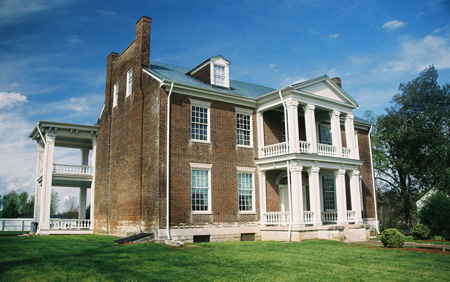 Randal McGavock (1768-1843) came
from Virginia and purchased the land in 1815. He became involved in
local and state politics and eventually served as mayor of Nashville
(1824-25). While most plantations in the South grew a single cash crop
like cotton, Carnton, however, was different with a diverse farming
operation consisting of a large orchard and several head of sheep,
cattle and hogs raised for sale in addition to raising thoroughbred
horses. Carton Plantation had somewhere between 20 and 40 slaves. The
mansion was built in 1826. Randal McGavock named his property after his
father's birthplace in County Antrim, Ireland. The Federal-style
plantation house became a social and political center where McGavock
entertained Andrew Jackson and James K. Polk and presided over an
estate that grew to 1,420 acres.
Randal McGavock (1768-1843) came
from Virginia and purchased the land in 1815. He became involved in
local and state politics and eventually served as mayor of Nashville
(1824-25). While most plantations in the South grew a single cash crop
like cotton, Carnton, however, was different with a diverse farming
operation consisting of a large orchard and several head of sheep,
cattle and hogs raised for sale in addition to raising thoroughbred
horses. Carton Plantation had somewhere between 20 and 40 slaves. The
mansion was built in 1826. Randal McGavock named his property after his
father's birthplace in County Antrim, Ireland. The Federal-style
plantation house became a social and political center where McGavock
entertained Andrew Jackson and James K. Polk and presided over an
estate that grew to 1,420 acres. Randal's son John inherited Carnton upon his father's death in 1843. In 1847, John McGavock added a two-story Greek Revival portico and two dormers in the attic just prior to his 1848 marriage to his cousin, Carrie Winder of Ducros Plantation in Louisiana (granddaughter of Tennessee legislator Felix Grundy), who bore him five children, three of whom passed away before 1862. A few years later, the couple added a two-story porch onto the rear of the house, which extended at one end to take advantage of southerly breezes.
At 4:00 in the afternoon of November 30, 1862, lines of Confederate soldiers, stretching two miles wide, marched past the mansion towards the Union defenses south of Franklin. As the battle raged towards the north wounded Confederate soldiers started streaming back. Carnton served as the largest field hospital in the area for hundreds of wounded and dying Confederate soldiers brought to the site for surgeries and medical care. Every room and hallway was used except for one small room upstairs used by the McGavock family. Several hundred eventually came to Carnton and 150 died that first night. During the tour, we could still see the blood stains on the wooden floor. The next morning, the bodies of four of the six Confederate generals killed during the fighting; Patrick Cleburne, Hiram Granbury, John Adams and Otho Strahl lay on the back porch.
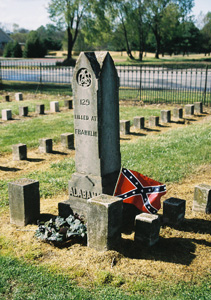 In 1866, John
and Carrie McGavock
designated two acres of land adjacent to their 19th century family
cemetery as a final burial place for nearly 1,500 Confederates. The
inscriptions on the grave markers, which had remained in place on the
battlefield, were carefully preserved by Carrie McGavock in the
Cemetery Record Book. The numbers on the present markers correspond to
numbers in the book. John and Carrie McGavock cared for the McGavock
Confederate Cemetery for the rest of their lives. John died in 1893 and
his wife in 1905. Carrie Windor McGavock took special care of the
cemetery until her own death at age 76 and became the subject of the
book Widow of the South.
In 1866, John
and Carrie McGavock
designated two acres of land adjacent to their 19th century family
cemetery as a final burial place for nearly 1,500 Confederates. The
inscriptions on the grave markers, which had remained in place on the
battlefield, were carefully preserved by Carrie McGavock in the
Cemetery Record Book. The numbers on the present markers correspond to
numbers in the book. John and Carrie McGavock cared for the McGavock
Confederate Cemetery for the rest of their lives. John died in 1893 and
his wife in 1905. Carrie Windor McGavock took special care of the
cemetery until her own death at age 76 and became the subject of the
book Widow of the South.Their son Winder McGavock inherited the plantation and lived there until his death in 1907. His widow sold it four years later. Today, the McGavock Confederate Cemetery is a lasting memorial honoring those fallen soldiers, and is the largest privately owned military cemetery in the nation.
The McGavock family owned Carnton until 1911. Carnton passed through several owners from the time it left the McGavock family until September 1978, when the Carnton Association acquired the house and ten acres and opened it as a historic site.
There is an organization called Save The Franklin Battlefield, Inc. that is trying to preserve what is left of the battlefield and other Civil War sites in Williamson County, Tennessee.

This website was created
in July of 2007
