|
|
Civil
War and After: 1861 to 1899
|
Charles S. Olden Republican Served:
January 20, 1860 to January 20, 1863
He entered politics as a Whig in
1844 when he was elected to the New Jersey Senate and served until 1850. With
the Whig Party fallen apart, Olden did not support either major candidate in
the highly contentious election of 1856 between Democrat James Buchanan or
the ‘new’ Republican Party candidate John C. Fremont. Instead he backed the
“Know-Nothing” candidate Millard Fillmore. Olden stayed out of the heated
debates over slavery during the late 1950’s. In 1860, the New Jersey
“Opposition Party” which was made up of former Whigs, Know-Nothings and
Republicans (after the election they would call themselves the Union Party
(they became the Republican Party during Reconstruction) who were in
opposition to the Democrats nominated Olden for governor. In the election, he
defeated Democrat Edwin R.V. Wright. Olden was elected governor in 1859 as the country was falling apart over the slavery issue. Personally he was not an abolitionist. Like many northerners, he did not believe in the expansion of slavery but supported the highly controversial Fugitive Slave Act. In the Presidential Election of 1860. He supported Abraham Lincoln over Stephen Douglas, John C. Breckinridge or John Bell. Within months of Lincoln’s election, seven states seceded from the Union. Olden was opposed to secession which he compared to anarchy. He believed that the problem was caused by a few extremist in both the North and the South. He supported a compromise that would to avoid Civil War. After both the U.S. House of Representatives and the U.S. Senate rejected Crittenden's proposal, a peace conference convened on February 4, 1861, at the Willard Hotel in Washington D.C. with more than 100 of the leading politicians. Olden was elected as one of the New Jersey delegates, the only sitting governor to attend. His biggest fear was that a civil war would split New Jersey. Ultimately the peace convention failed. On Friday, April 12, 1861, at 4:30 a.m., Confederate batteries opened fire on Fort Sumter in Charleston Harbor. Olden’s fear that New Jersey would be split over the war disappeared when the war started. New Jersey was enthusiastic in its support of the Union. Many, like Olden, who favored compromise months earlier, were now totally committed to war against the rebellious Southern states. He worked tirelessly to raise troops for the Union army. He worked late into the night sometimes even sleeping at his desk. At the end of his term, he was term limited and could not run for re-election. The Republicans nominated Marcus Ward for Governor in 1862, but he lost to Democrat Joel Parker by one of the largest margins in state history. Even after leaving the governorship, Olden continued to support the war effort. His work also strengthened the Union (Republican) Party in New Jersey. After the war, he was appointed
to serve on the New Jersey Court of Errors and Appeals, then the state's
highest court (despite not being a lawyer), serving from 1868 to 1873. In
1872, Olden was selected as a Presidential Elector for New Jersey during the
Republican National Convention in Philadelphia. President Grant was
unanimously re-nominated for a second term the convention's 752 delegates. He was a Trustee of the College of New Jersey (now Princeton University) from 1863 to 1875. The following year, in 1876, Olden died at Drumthwacket. |
|
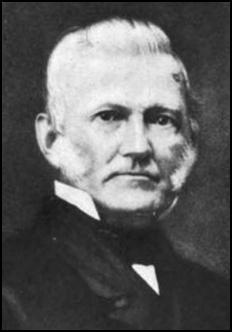
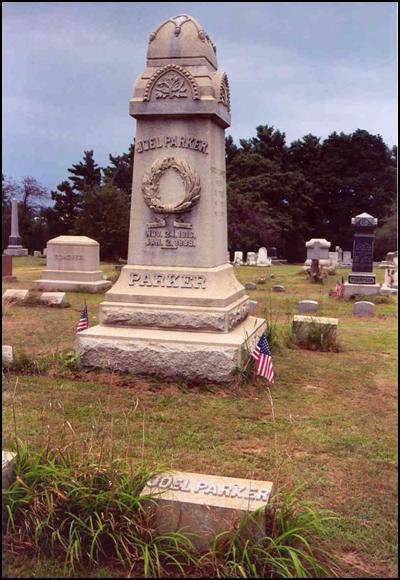
Joel Parker Democrat
A Democrat, Parker was elected to the New Jersey General Assembly in 1847, where he served until 1851 when he was appointed the "prosecutor of pleas" of Monmouth County. He continued to be active in politics and served as a New Jersey elector in the 1860 Democratic National Convention in Charleston, South Carolina were he voted for Stephen A. Douglas of Illinois. The following year, after the Civil War broke out, Governor Charles S. Olden appointed Parker a Major General of the New Jersey militia.
Only a year later in 1862, Parker ran for governor as a "War
Democrat" who supported a military solution to the Civil War rather than
those Democrats who advocated a peaceful solution with the Confederacy (those
Democrats were called "Copperheads"). He defeated Newark mayor
Moses Bigelow for the nomination of the Democratic Party. In the general
election, Parker defeated Republican Marcus L. Ward by the largest margin in
state history (14,394 votes). Although staunchly in favor of the war, Parker
was also highly critical of the Lincoln Administration's actions with respect
to curtailing civil liberties in the name of the war effort, criticizing
Lincoln for suspending habeas corpus and for what Parker considered the
unconstitutional nature of the Emancipation Proclamation. After his term as governor was up he returned to his law practice. Republican Marcus L. Ward overcame his loss in 1862 and won the next election to be governor. Parker, though, was the "favorite son" candidate supported by New Jersey electors at the Democratic National Conventions in 1868, 1876 and 1884. After Democrat Theodore F. Randolph's term as governor was over, Parker was re-elected Governor in 1871 and served until 1874. He became the first person to be elected to two non-consecutive terms by the people. As governor, he called for the end of Reconstruction and the protection of States' Rights. After his second term was up, he was named Attorney General of New Jersey and later served as a justice on the New Jersey Supreme Court from 1880 until his death in 1888. |

|
Marcus L. Ward Republican
He was an Anti-slavery Republican who even went to "Bleeding Kansas" in 1858. He was a delegate to the 1860 Republican National Convention in Chicago that chooses Abe Lincoln as their candidate. The Republicans nominated Ward for Governor in 1862, but he lost to Democrat Joel Parker by one of the largest margins in state history. During the Civil War, Ward became known as the 'soldier's friend' for his many donations he made to help the soldiers. He established Marcus L. Ward's Office for Soldier's Business - a private bureau which secured soldier's pay and transmitted it to their families. In 1862, he borrowed money from the N.J. state government and leased a four-story building to begin the Ward U.S. Military Hospital in Newark. The Ward Hospital, with accommodations for 1,400 patients, was located in several factory and warehouse buildings east of Centre Street and between the railroad tracks of what is now the freight station of the Pennsylvania Railroad, and the river. The wounded and sick men were brought in from the front or from other hospitals, in trains and moved directly out of the cars into the hospital. In 1865 it became the Soldier's Home. Ward was also the chairman of the Public Aid Committee of Newark. Ward's active interest in the welfare of Civil War veterans and their families continued during the years of Reconstruction. Following the war in 1866, Ward was named the Chairperson of the Republican National Committee. He was the third person to serve in this position (replacing newspaper owner Henry J. Raymond of New York). He served until 1868 when he stepped down to run for governor (he was succeeded by William Claflin of Massachusetts). Ward is the only New Jersey governor to be Chairman of the RNC.
He is the namesake for "The
MARCUS L. WARD HOME for AGED and RESPECTABLE BACHELORS and WIDOWERS"
in Newark (founded by his son) – today its Winchester Gardens. I wonder where all of the non-respectable bachelors go? In the Spring of 1884, Ward and his wife traveled to Florida. While there he contracted malaria. He returned to his mansion at 49 Washington Street in Newark where he died. Today the site is part of the location of the Newark Museum. His carriage house on University Place is the Newark Fire Department Museum. |
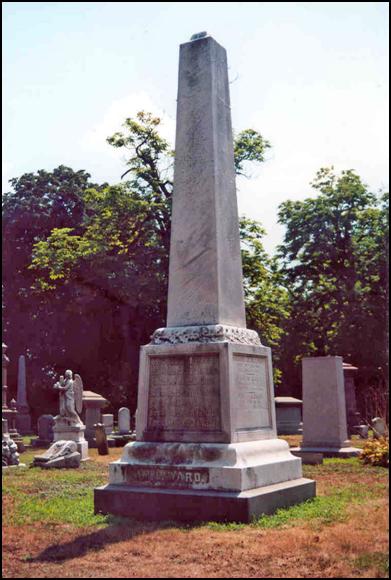

|
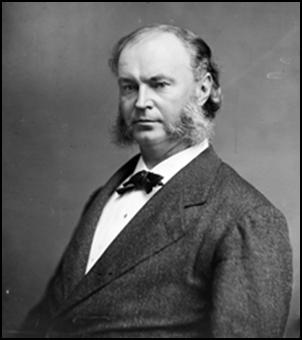
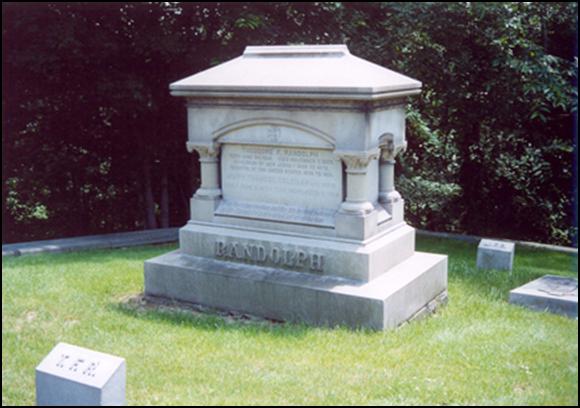
Theodore F. Randolph Democrat
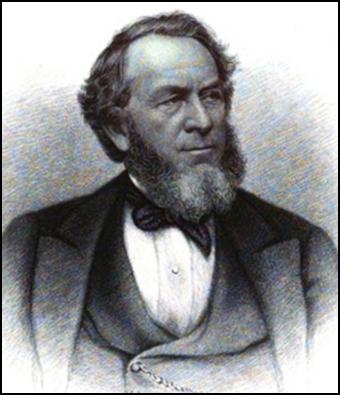
Randolph was governor (1869-72) after the Civil War when Ulysses S. Grant was president. You can also see that he is very fashionable, sporting those sideburns that General Ambrose Burnside made so popular. Randolph was the first of seven consecutive democrat governors of New Jersey (Werts was the 7th). Somewhat odd since the country was mostly Republican during the post-Civil War period. After growing up in New Brunswick, Randolph moved to Vicksburg, Mississippi. He returned to New Jersey in 1852 - living in Jersey City. He was one of those railroad tycoon guys. In 1859, he was elected to the State Assembly and then the State Senate in 1862. Randolph (representing Jersey City), along with another future governor Joseph Bedle, were members of the Democratic Convention of 1864 which met in Chicago and nominated George B. McClellan (future New Jersey governor) and George H. Pendleton of Ohio as president and vice-president. They lost badly to Abraham Lincoln in the general election (of course, New Jersey was one of only three states that McClellan carried). After serving one term as governor, he was elected to the U.S. Senate for a term (1875-1881) in the 46th Congress. He did become chairman of the Committee on Military Affairs. Randolph also invented a stitching machine and a steam typewriter. He died in Morristown less than three years after leaving the Senate. |
|
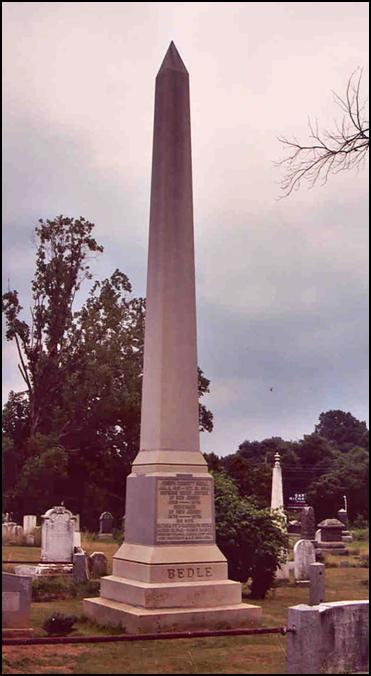
Joseph D. Bedle Democrat
In 1877, during a railroad strike
in New Jersey, Bedle called up the National Guard to protect the interests of
the railroads. After completing his term, Bedle
resumed his legal career. He returned briefly to politics in 1894 serving on
the New Jersey Constitutional Commission. He turned down ambassadorships to
Russia and Austria. Bedle died at St. Luke's Hospital in
New York City on October 21, 1894 from complications from a gall bladder
operation.
|
|
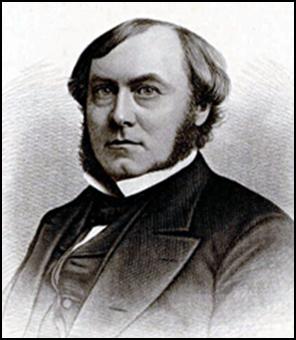
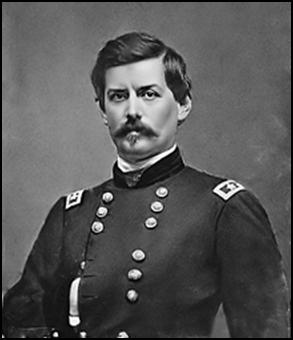
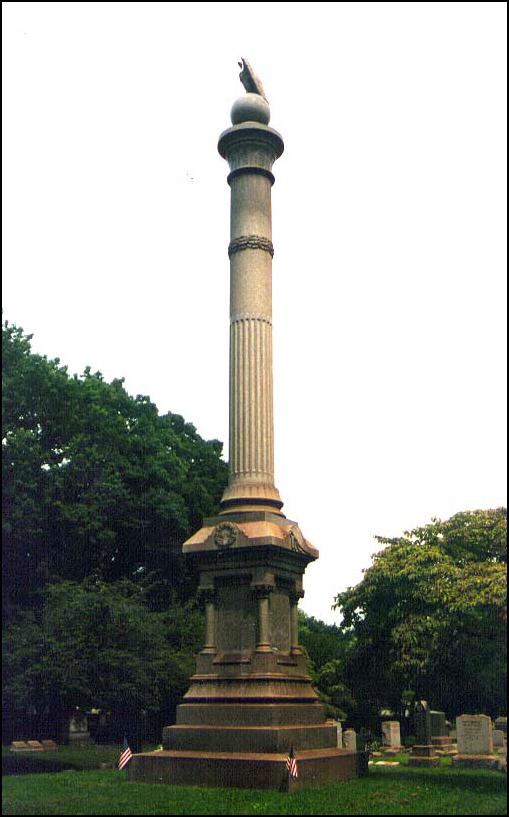
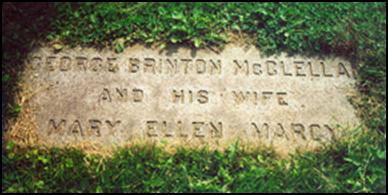
George Brinton McClellan Democrat
At the outbreak of the Civil War, he was appointed a major general of Ohio volunteers. He earned some minor success in West Virginia and, after General McDowell's disaster at the First Battle of Bull Run, was appointed commander of the Army of the Potomac in August of 1861 and top commander of all Union Armies a month later. He set about bringing order and discipline to the demoralized Union Army earning him the high popularity of his men who referred to him as "Little Mac." By order of President Lincoln, McClellan reluctantly moved against the South in early 1862. He moved his vastly numerically superior force toward Richmond in what has been called the Peninsula Campaign. A series of battles around Richmond called The Seven Days Battle were indecisive for either side, yet McClellan, falsely thinking the Confederates had a much larger army, chooses to retreat. His army was taken away from him and given to General Pope who was decisively defeated at the second Battle of Bull Run in August of 1862. McClellan was once again in charge of re-organizing the army to their delight. In September, General Robert E. Lee moved the Confederate Army of Northern Virginia into Maryland. McClellan moved the Union Army north to meet him. Despite having Lee's plan fall into his lap, he refused to act quickly enough. McClellan attacked Lee outside of Sharpsburg, Maryland on September 17, 1862 at the Battle of Antietam in what became the bloodiest day of the war. McClellan had superior numbers but did not have a coordinated attack and was not able to defeat Lee. After the battle, Lee retreated back into Virginia. Even though he drove the Confederates out of Maryland, McClellan missed a golden chance to crush Lee's Army and possibly end the war. After the battle, he refused to go on the offensive and two months later was relieved of command.
After the war, McClellan traveled around the world and held various positions, working on various engineering projects. In 1877, McClellan was nominated by the Democrats for governor and in the election easily defeated Republican William A. Newell. As governor, he did not get along well with the Democratic state Senate who were making political maneuvers to ensure their domination of state politics. This didn't work, and the Republicans regained control two years later. His major efforts were the elimination of taxes and the improvement of the National Guard. McClellan never favored any policy that might be considered controversial and never tried to exert leadership over the legislature. Overall, he was only a fair governor. When McClellan's first term was over in 1881, he retired to his home in Orange. He died there less than five years later at age 58 of heart problems. |
|
George Craig Ludlow Democrat
Born in Milford, New Jersey, Ludlow moved as a child to New Brunswick, where he lived for the rest of his life. Both his father and his grandfather were active Democrats. Ludlow graduated from Rutgers University in 1850. He was married, Mary, and had two sons. A lawyer for the powerful Pennsylvania Railroad, he soon entered politics himself and was elected as a Democrat to the New Jersey Senate in 1876 and was chosen as Senate President in 1878.
The election was also heavily influenced by railroads. Ludlow was a lawyer for the Pennsylvania Railroad while his Republican opponent Frederic A. Potts was a major stockholder in the Jersey Central railroad. In the general election, Ludlow narrowly defeated Potts, by the small margin of 651 votes out of some 250,000 ballots cast (the closest election in New Jersey gubernatorial elections) This was the year of a national Presidential election, in which New Jersey went for Civil War general Winfield Scott Hancock (Democrat) who ultimately lost to another Civil War general, James A. Garfield (Republican). Because Ludlow had won be such a narrow margin and he owed his nomination to the “State House Ring,” he had little political clout. Ludlow than took on the railroads. A bill designed to give the board of directors of the Jersey Central Railroads over the stockholders was vetoed by Ludlow. He thought it was immoral and unjust. Unfortunately, the state legislature overrode his veto. Next he took on his former employers, the Pennsylvania Railroad. The railroads had been given underwater land grants by the state. The railroads engaged in extensive landfills to increase their properties. The railroads owned much of the Jersey City waterfront around Exchange Place and were building tracks, terminals and warehouses. They denied the residents of Jersey City access to the waterfront. When their plan was pointed out in the local newspapers, the residents became outraged. Jersey City objected but the railroad got the state assembly to allow it. Ludlow vetoed the bill calling it an, “abuse of legislative power.” The veto would have been overridden if bribery charges weren’t brought against members of the state assembly. Ludlow goal was to alleviate the tax burden of the citizens. He focused his plan on the railroads that were exempt from local property taxes. He tried to get the legislature, which was heavily influenced by the railroads, to pass laws that revoked those exemptions but lacked the political power to get it accomplished. Ludlow served only one term. He was honest and hard-working but unproductive. He lacked the political power to control a divided legislature that was dominated by special interests like the railroads. His use of his veto power in the interest of the people did set a moral tone that was needed during the Gilded Age of the 1880’s. Also, he laid the groundwork for curbing the power of the railroads that the next governor would achieve. After leaving the governorship, Ludlow staid out of politics. In 1895, Governor George T. Werts appointed Ludlow as an associate justice of the New Jersey Supreme Court. Five years later, he died of heart disease at age 70 in his home in New Brunswick. |


|
Leon Abbett Democrat
Born in Philadelphia, Pennsylvania, Abbett was the son of Ezekiel and Sarah Howell (who are also buried in Green-Wood Cemetery with him). He attended the elite Central High School in Philadelphia (the second oldest continuously public high school in the United States). Despite being a public school – it had an all-white male student body. He graduated in their 112th class. He was admitted to the Philadelphia bar in 1858. In April 1861, feeling his prospects were limited in Philadelphia, he decided to move to New York City to open a law firm and formed a partnership with William Fuller. The same time as Abbett was moving to New York City, the Confederates fired on Fort Sumter in Charleston harbor starting the Civil War. Many in New Jersey rushed to join the Union Army. As a states’ rights Democrat, Abbett was opposed to war and did join. As the war dragged on, Abbett staid with the anti-war Democrats. He wanted the Union to survive but was opposed to emancipation. Abbett married Mary Briggs of Philadelphia in 1862 in the Episcopal Church of the Nativity in Philadelphia. The couple moved across the river to Hoboken, New Jersey. A lawyer and Democrat, he soon entered politics in New Jersey and in 1864 campaigned for the New Jersey General Assembly. Politically, he wanted the Union to survive but was opposed to the draft and any emancipation of the slaves. He played on the racial fears of the Irish immigrants living in Jersey City. He used these arguments against his Republican opponent successfully. He served in the Assembly to 1866 and again in 1869 to 1870. During his second term, Abbett served as Speaker of the General Assembly. He supported General George B. McClellan in the Presidential Election of 1864. Just before the end of the war, Abbett gave a speech opposing ratification of the 13th Amendment ending slavery. He was against abolition feeling it would hurt reconciliation with the South (New Jersey ultimately ratified the 13th Amendment.) He also showed his disdain for President Lincoln. When he ran for re-election to the General assembly in 1865, his victory was much closer as his antiwar stance was seen by some to be treason. To make it harder, Republican power was growing in New Jersey – winning the governorship (Marcus L. Ward) and control of both houses of the legislature. Abbett stuck to his beliefs – he voted against the 14th Amendment (which would give citizenship to former slaves.) Feeling that Jersey City held more political opportunities than Hoboken, Abbett and his wife moved there in 1870 buying a house at 16 Sussex Street – next door to conservative Democrat and future governor Joseph D. Bedle. Despite being political rivals they became friends (Bedle was 15 years older.) He was elected to a number of municipal positions in Jersey City like the Board of Education. In 1875, Abbett was elected and served one term in the New Jersey State Senate from 1875-1877, the last year serving as president of the Senate.
In 1877, while he was
president of the senate, Abbett again set his eyes on becoming governor. He
was considered the front runner but there were those out to stop him. His
political opponent was Hudson County rival Oretes Cleveland (former and
future mayor of Jersey City). Cleveland claimed that Abbett had not played
fair with him in past campaigns and political manipulations, so he used his
managerial ability to block Abbett. The powerful “State House Ring” looked to
stop Abbett. A group of Randolph Democrats met to come up with a plan to
nominate someone else. They invited Cleveland to help. The group came up with
a secret plan to wrest the nomination away from Abbett at the convention. At
the convention, held in the Taylor Opera House in Trenton, it appeared to be
between Abbett and John Stockton, grandson of the Declaration of Independence
signer Richard Stockton. A carefully orchestrated plan brought former Civil
War general George B. McClellan forward in the
convention. Abbett was unable to stop the momentum as McClellan won the
nomination and later the general election to become the 23rd Governor. Abbett
was shocked that the nomination was stolen from under him by political
maneuvering. However, instead of sitting out the election, he increased his
own political standing by campaigning for McClellan. Three years later, Abbett’s wife Mary died in June of 1879 of incurable cancer that she had been suffering from for over two years. Abbett would never get over this loss and decided that he would not run for the governership in 1880. Since McClellan decided not to run for another term in 1880 there was an opening on who would succeed him. Since Abbett decided not to run, his old political opponent and adversary Oretes Cleveland decided to run. When Abbett heard of this, he immediately decided that this could not happen. They entered into a desperate fight for the control of the Democratic State Convention that met in Trenton to nominate a candidate for Governor. Cleveland wanted it, but Abbett was too clever for him and, setting aside his own ambitions, he joined with the State House Ring, his former enemies, in order to block Cleveland. After one of the most disorderly sessions any Democratic convention ever had held, George C. Ludlow, Democratic State Senator from Middlesex County, was nominated and defeated Republican Frederic A. Potts, by the small margin of 651 votes, to become the 24th Governor. Following Democrat Ludlow, Abbett was finally elected Governor of New Jersey in 1883. Abbett was the sixth consecutive Democrat governor. He was followed by Democrat Robert Stockton Green for one term and then Abbett was elected for a second term from 1890-1893. Even though he was a machine politician and party boss, Abbett, who was called "The Great Commoner", has been called a dynamic and visionary leader as well as a reformer who guided New Jersey into a new urban industrial age. Looking out to help the deprived urban lower classes who he saw as being oppressed by Big Business, he set out during his first term as governor to tax the railroads. The railroads that were exempt from local property taxes. This was a major challenge considering the power the railroads held, but he ultimately prevailed. After his first term as governor, he ran for a seat in the U.S. Senate in 1887, but lost the Democratic nomination to Rufas Blodgett (who ultimately won the election and served one term). The powerful railroads, still smarting from Abbett's victory over them, used their power to have him defeated. In 1889, Abbett ran for a second term and won. During his second term he passed a number of reforms like a law to reduce voter fraud and another to outlaw segregated cemeteries. He set out to improve the lives of the common worker. He had laws passed that improved working conditions in factories, eliminate child labor, set a maximum number of hours in a working week and outlawed the use of Pinkerton detectives by large factories to break up labor strikes. Abbett also created a state police force to maintain peace in the industrial areas. As his second term as governor was ending in 1892, Abbett ran for the U.S. Senate again but lost the Democratic nomination to James Smith, Jr. (who ultimately won the election and served one term). After his defeat, he was named an Associate Justice of the New Jersey Supreme Court by Governor George T. Werts, whose election Abbett had helped secure, and served from 1893 until his death the following year. Abbett was a Freemason. He would suffer personal tragedy again in July of 1893 when his oldest son William died suddenly of a brain aneurysm. Abbett did live to see his only daughter Mary get married in St. Matthew’s Episcopal Church in Jersey City in April of 1894. He died later that year in his Jersey City home, on the northeast corner of Montgomery and Jersey Avenues (today it’s the site of the Jersey City Library), after an attack of diabetes at the age of 58. He had a large state funeral with thousands of mourners led by Governor Werts. After the funeral at his house, the funeral procession crossed into New York City, over the Brooklyn Bridge to Green-Wood Cemetery in Brooklyn.
There is a book about Leon Abbett called Leon Abbett's New Jersey:
The Emergence of the Modern Governor by Richard A. Hogarty. |

|
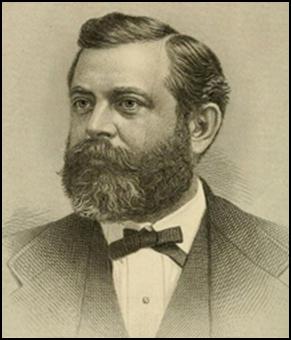
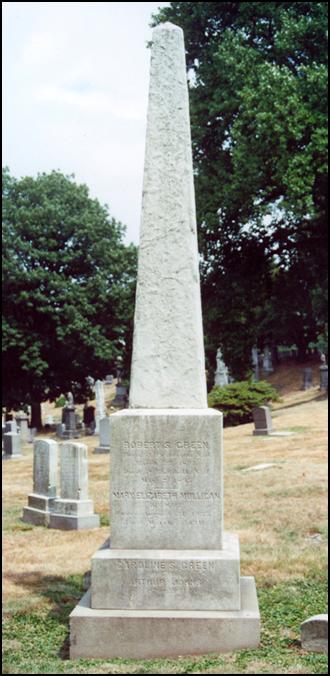
Robert Stockton Green Democrat
Born into an illustrious New Jersey family, Green graduated from the College of New Jersey (later Princeton University) in 1850. His father, James Green, a democrat ran for the governorship in 1837, but lost to Whig candidate William Pennington (12th governor above). Following in his father’s footsteps, Green became a lawyer and then entered politics. He moved to Elizabeth and in 1857, he married Mary E. Mulligan. In 1857, Green became the prosecutor of the borough courts and then later that year, city attorney of Elizabeth. He remained in this post until 1868. In 1860, Green was a delegate to the volatile Democratic National Convention that started in South Carolina Institute Hall in Charleston, South Carolina then later reconvened at Maryland Institute in Baltimore, Maryland that nominated Stephen A. Douglas of Illinois (he lost to Lincoln). He was also a surrogate of Union County from 1862 until 1867. He was elected to the Elizabeth city council in 1863 and served for ten years. In 1868, he became the presiding judge of Union County Court of Common Pleas 1868 and served until 1873. Green was also a member of the commission to suggest amendments to the constitution of New Jersey in 1873. He was admitted to the bar of New York in 1874. As a lawyer, green fought the railroad monopoly held by the Camden and Amboy Railroad, which held all transportation rights between New York and Philadelphia bringing him popularity. In 1880, he was a member of the Democratic National Convention in Cincinnati that nominated Winfield Scott Hancock (hero of the Battle of Gettysburg) for the presidency (he lost to James Garfield). In 1884, Green successfully ran for the U.S. Congress and served one term in the U.S. House of Representatives until his resignation on January 17, 1887 to become governor. While he was in Congress in 1886, Green successfully defeated Republican Benjamin F. Howey to become governor succeeding Democrat Leon Abbet. One of the major issues of the election was temperance (drinking of alcohol). Since Irish-Catholics were unfairly blamed for this, Green went after the Irish vote helping him win. A third-party candidate on the prohibition ticket helped Green also by taking votes away from Howey. He was again a delegate to the 1888 Democratic Convention in St. Louis that nominated Grover Cleveland of New York for president and Allen G. Thurman of Ohio for vice president (this was the election that Cleveland did not win). Green's low-key style of co-operation instead of leadership made him fairly ineffectual as governor. He failed to carry out many of the reforms needed in the state. Most of his administration was occupied with the problems of alcohol. Many people were upset that state liquor laws were being ignored (especially in Jersey City). The Republicans were pushing for prohibition in the state. His veto of a temperance law was overridden by a Republican controlled legislature. As the issue got hotter, Green decided to stay on the sidelines. Green also alienated the Irish, who supported him in the election, when he refused to go to an Anti-British rally. He left office after serving one term and was appointed vice chancellor of the State in 1890 by his successor, Leon Abbet (serving his second term). He served until 1895. He was also appointed a judge of the court of errors and appeals in 1894 and 1895. Green was not considered a good governor because he failed to realize what it meant to be governor. |
|
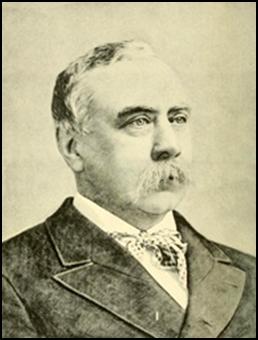
George T. Werts Democrat
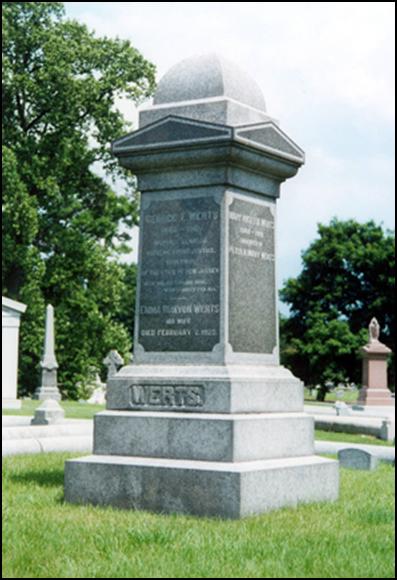
George Theodore Werts was governor at the end of the 19th Century (1793-96) when William McKinley was president. Werts created the Palisades Interstate Park Commission which saved the Palisade cliffs from being quarried for its rock (have to give him credit for that). This one was tough to find. We had a location, but there is nothing in the cemetery to tell you what section you’re in, so having a location is fairly useless. It's like having an address, but none of the streets having signs. On top of that, we drove past this marker, but didn't notice it because there is a different name on the reverse side. Turns out, the two governors are very close to each other. In 1863, Werts moved to Morristown at age 17 and soon became a lawyer. He built a law practice over the next 16 years. In 1872, he married Emma Stelle. Werts, a Democrat, entered politics and in 1886 was elected mayor of Morristown (surpassingly since Morristown was heavily Republican). He was also elected to the state senate at the same time serving for five years. Werts moved from Morristown to Jersey City and lived in a mansion on Crescent Avenue on the present site of Lincoln High School. Wanting to get him out of the way politically, Governor Leon Abbett made him a state judge in 1892. However, he than supported him to be his replacement when Abbett ran for the U.S. Senate. Werts, riding Grover Cleveland's coattails, defeated the Republican candidate John Kean, Jr. However, as governor, Werts was fairly ineffectual. His administration was mired in a racetrack gambling controversy which hurt the entire Democratic Party in the state. His lack of leadership caused both parties to fight over power.
In 1895, a scandal involving corruption among many Democratic legislative was
exposed. Though Werts was not involved, this brought an end of a quarter of a
century domination of New Jersey politics by the Democratic Party. He was the
last of seven consecutive Democratic governors. Leaving office after one
term, Werts returned to his law practice in Jersey City. He and his wife Emma
would live at 27 Danforth Avenue in Jersey City and
would die 20 years later at age 63. |

|
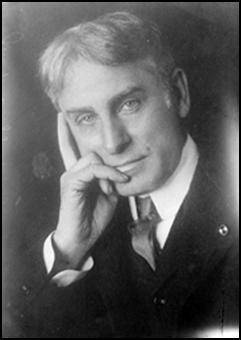
John W. Griggs 29th
Governor of New Jersey Republican Served: January 21, 1896 to January 31, 1898
Griggs graduated from Lafayette College in 1868 and became a lawyer in Paterson three years later. A Republican, he became active in politics. Griggs was a member of the General Assembly of New Jersey in 1876 and 1877. He was elected State senator for Passaic in 1882 and again in 1885. Griggs served as president of the New Jersey Senate in 1886. He was a delegate to the 1888 Republican National Convention in Chicago that chose Benjamin Harrison for president. In 1895, Griggs ran for governor. It He resigned as governor in January of 1898 to accept President William McKinley's appointment as the 43rd Attorney General of the United States, which he held until March 29, 1901. He was one of the first members appointed to the Permanent Court of Arbitration at the Hague and served from 1901 to 1912. In 1904, Griggs failed in his bid to be elected to the U.S. Senate when the Republican controlled state legislature choose incumbent John Kean, who Griggs had defeated in the Republican primary for governor back in 1895. This was when state legislatures, and not popular vote, selected U.S. senators. The first direct election of U.S. senators in New Jersey would be in 1916. Griggs is the only New
Jersey Governor to serve as Attorney General of the United States. |
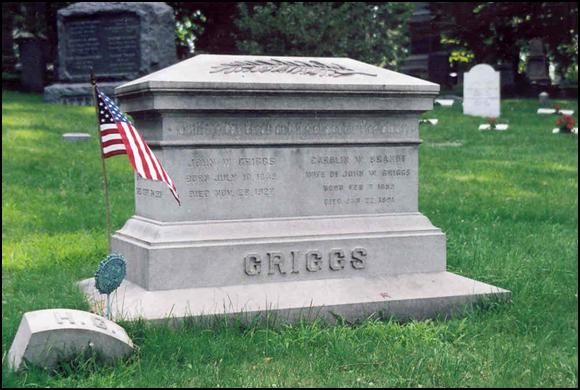 Driving around a section, Debbie spotted Griggs next to a bend in the road.
This was the second one she found this day. After a photo, we set out looking
for the other dead governor (Philemon Dickerson). We found it just after we
had given up and were heading for the exit. Not a bad day, three dead
governors and a mocha frappuccino.
Driving around a section, Debbie spotted Griggs next to a bend in the road.
This was the second one she found this day. After a photo, we set out looking
for the other dead governor (Philemon Dickerson). We found it just after we
had given up and were heading for the exit. Not a bad day, three dead
governors and a mocha frappuccino.
|
This website created and maintained by Frank McGady You are visitor number: E-mail me
with any comments, questions or corrections you might have |